Showing posts with label BMW. Show all posts

Saturday, June 30, 2007

India, the last few kilometers.


(Varanasi, road sign)

All good things must eventually come to an end, and so it was with India. Cecilia had taken off, and I decided to stay a couple of extra days and have a look at Konark. (See previous blog). I also checked out the little fishing village just north of Puri, which was very interesting. Life unfolding right on the beach. Whether it was sorting fish, playing children, or the beach as an open air toilet. I also caught a very lively game of Cricket at an open field where the previous morning the whole village were taking care of their morning toilet (men only). Makes me wonder though, 4000 years of history, and they haven't figured out how to dig a hole in the ground, and put some walls around it. A common sight all around rural India in the morning by the way.


(Varanasi, sunset)

Somehow, by the time I left Puri, I was only interested in getting out of India. My mind was already on mountains, and something "different". So, I pretty just rode straight out of the country by the fastest way possible. No more sightseeing or playing tourist.
Because of continuing problems with the border entrances in the eastern part of Nepal, both Cecilia and I had decided to head to Sunauli, which is in the center of Nepal, north of Varanasi.

(Varanasi, along the Ganges)

The northern part of India was by far the poorest, most rural, crowded and "un-enjoyable" part of India which I had experienced. Including lots of "agressive" people everywhere. Something that I was surprised about. Everywhere else I had been in India, they the people are curious, but usually respectful, here as in Puri they were very hands on and "agressive", not very enjoyable. In addition to all this it was very dusty, hot and for my money with a few minor exceptions not all that scenic. The roads were under construction in many places making travel a real nightmare. I am not going to get into traffic situation, as it is a constant when traveling in India and doesn't really require any further explanation.


(Varanasi, Ganges)

From Puri I basically got to Varanasi in two days, and then from Varanasi I made it to Pokhara in a day. Varansi was a real interesting place, and will definitely spend more time there next time I come this way. But as I mentioned earlier, by this time I was only interested in leaving India as fast as possible. The Ganges river runs through town and it is one of the holiest cities in India. Apparently if you die in Vanarsi you go straight to heaven. As I got there fairly late in the afternoon after a long and harrowing ride, I didn't get to see very much, oh well, there is always next time.


(Varanasi, Ganges)

The following morning, I headed north to the border. One little tip, if there is a town you want to avoid traveling through it is Gorakhpur, unfortunately I wasn't that lucky. In the end it took asking 5 people, 3 policemen and some luck to find my way through. The border crossing is pretty hectic, as the border point is in the middle of town (or what seemed like it). Traffic parked in the middle of the road while the officials in open fronted buildings on either side took care of required paperwork. Luckly the procedure is wasn't all that complicated, and in 45 minutes I was in Nepal.
Some closing remarks on India are a lot more difficult to think of than I thought. All in all I really enjoyed my stay in India. But when I try to think of what it is that I enjoyed, I am hard pressed to come up with anything specific. The country is basically a mess. It is corrupt, burocratic, un-reliable, chaotic, dirty and generally speaking well worth a third world developing nation status (which of course they are trying very hard to get away from and to a large extent have managed to do). Strangely enough, all these things and many more negative impressions are relative. This is the way India is, and you simply have to accept it to get to the rest. If you can't see past all of the negatives, you will miss out on the huge diversity of the Indian people and country. The fact that it is country of huge possibilities, and it will be one consumer paradise without equal, bar China, soon, cannot be denied. It is modern in places, often a stones throw from places which haven't changed in centuries. It is both progressive and so backward that it is almost amazing that it is possible. The people are stratling two worlds and it is very interesting to see how they mix the two. Whether it is the westernized disco party girls, who will marry the person their parents pick for them. Or the desire to posses all the trappings of the western world rather than proper shoes for their children. The huge middle class (300+ million) seem almost out of place in their own country, considering how a large majority of people are barely getting by. All these things are true and many more about India, and they are not all that keen on hearing about the problems and would rather talk about the positives. I don't blame them, like a Masala film, it is all about escaping reality. But they will have to face the problems and solve them before they are ready to take to the worlds stage and are able to command respect on an international level.
After having spent some time in India, nothing I read in the papers or hear on the news about India is can be a surprise. That is the way India is. They have real problems, which no-one but the Indians are going to be able to solve, western solutions simply do not apply here. I am looking forward to coming back and spending more time here and see more of the country and meet more of its people. Assuming they let me in after having read this.

Tuesday, March 13, 2007

Sun Temple, Konark, Orissa


I though I would share some pictures of the Sun temple at Konark with everyone. No real blog entry, as I haven't done anything other than had a look at this place. Really nice and it is incredible how much detail has gone into it. Enjoy.

Tomorrow I head towards Nepal, so I won't have another update until I get to Pokhara (probably).


Saturday, March 10, 2007

Puri, Orissa India, 10.03.2007 Part 3

Hey, I'm back. As promised, below is a copy of a newspaper picture which appeared here the day after we changed our tires in the middle of Puri. (See previous post..). Unfortunately (or maybe fortunately) there is no article, only a caption. Sorry, I can't translate, but the gist is Cecilia & Khim Rojas from Switzerland on a world tour by motorcycle. Or something in that general direction.


Puri, Orissa India, 10.03.2007 Part 2


Getting our tires changed in the middle of Puri, Orissa

Well, in due time our tires arrived and we had them mounted at a nice little tirewallah in the middle of Puri. We literally stopped traffic, and the police had to step in. In the end there were three police persons (2 female, 1 male), hitting the bystanders with cane sticks to get them to move. The police started to get irritated at us, and the tirewallah, and told him to work faster, and tried to get us to move. They left us alone once they noticed that the tire was off the bike, but they weren't very happy.
In the time we were there (about 1 hour), Cecilia gave three interviews, or what passed for an interview. Someone pointed a camera at her and asked where are you from, and for her name, that is about it. The result can be seen below.
The following day (today), we have been stopped three times already and asked if we were the Swiss people. Apparently not only did an article appear in the Times, but also in the local language paper, with a photo. I will scan this in and post it the next time I get a chance.

---------------------------------------------------------------------------------------
The Times of India, Bhubaneswar-National Saturday, March 10, 2007
Wanderlust drives them around the world.
Debabrata Mohapatra - TNN

Puri: They say when the travel bug bites, it makes you do the most craziest of things to satisfy your wanderlust.
Ask Cecilia and Kim Rojas of Switzerland, they have sold off all their belongings and are using their lifetime savings for a trip around the world on their giant motorcycles.
The couple in their late thirties, have traveled across 12 countries covering nearly 31,000 km on the road. They reached the shores of Puri last week after traveling to various places across the continent for the last five months.
"We chalked out out plan for a world tour on motor bikes in 2004. Since then we started saving money for the purpose. We also raised some money from our friends and relatives," says 35-year-old Cecilia. The couple began their journey on October 10, 2005 from Lucerne in Switzerland.
They entered India from Pakistan at Amritsar through the Wagah border.
"We chucked out jobs and sold our belongings before starting this adventure. It was a dream come true for us the day we set off on this daredevil journey on two motorbikes," says Cecilia, a computer engineer like her husband.
"We decided to take two bikes because one bike is not enough for two. There's hardly any space left for the pillion rider after all the stuff have been loaded.
We've brought everything required for us on the bike, which forced us to go for two bikes," says Kim.
The couple are clear about what they want from the journey and spreading any message or creating a record is not on their agenda, they just want to enjoy wandering across the globe.
"We want to cherish our dream of visiting around the world on a motorbike.
But during our we have got a chance to learn the art and culture of different places.
We are really enjoying that," says Cecilia.
Kim and Cecilia do their best to keep their two BMWs in shape for the journey.
"We ride for nearly eight hours a day.
If we ride harsh, then the bikes cannot fulfill our dream.
Till now we have managed to sort our whatever small technical faults we encountered on our own," she says.
Kim says they have not faced any hurdle so far while crossing the borders of various countries.
"We have all the valid documents like passport, identity card and motorbike papers with us.
We found India pretty safe, though we never ride after dark," says Kim.
He says their journey will continue for another two years, but did not divulge their future destinations.
Talking about their experience in India, the couple say the hospitality they got at various places speaks volumes of the kindness and generosity of Indian towards visitors.
---------------------------------------------------------------------------------------

For the record, I gave no quotes whatsoever. The whole time I was working with the tirewallah to get the tires changed. Fighting people off the bikes so that we could get the work done. I am not even going to go into the details like, the fact that we have covered 22 countries, and gone over 60,000km to get here. It was very nice of him to label us as mid 30's though! Oh, and for the relatives and friends, don't feel left out if you didn't contribute to our journey, as we have not raised any money from our friends or relatives (of course if you want to contribute...). Also, my name is Khim...

Friday, March 09, 2007

Puri, Orissa India, 10.03.2007


Kanyakumari, Tamil Nadu (in the foreground a sunrise/sunset viewing platform)

Well, it looks like I am now in North India, or at least this is where the guidebook for southern India stops. To get here I have traveled along the coast of India to the southern most tip and then up along the coast on the opposite (eastern) side.
After leaving Kovalam, I headed straight to Kanyakumari, which is the town at the southern most point on the Indian Subcontinent. It was a short ride from Kovalam, and I got there early in the morning. Just in time to watch the thousands of tourists coming back from the various viewpoints where they caught the sunrise. As I was so early I just took a couple of pictures and continued on. The town itself is a major stopping point for Indian tourists and pilgrims. It is a very significant spiritual place for the Hindus. As such there is a major Hindu temple at the very tip as well as memorial building to Gandhi and a huge statue of Thiruvalluvar a Tamil poet, which is India's "Statue of Liberty" (says so in the Lonely Planet!). One of the major surprises was once I was headed north I started to go through areas full of wind turbines, something which for some strange reason looked completely out of place, but on hindsight, made perfect sense, it is after all a very windy area.


Rameswaram (Ramanathaswamy Temple), Tamil Nadu

The roads had gotten pretty bad nearly the moment I got into Tamil Nadu so the going was slow, but I decided to head to Rameswaram, which I thought looked like a pretty cool place on my map. Getting there on the back roads was an adventure in itself. The advantages of which were that there was little traffic, and you got to go through a lot of little villages where no-one had ever seen any tourists. Plenty of little very colorful temples and plenty of fields, rice, sugarcane and the like. I had hoped to get more of a glimpse of the ocean, but no luck. Basically the same as in most of India, the area along the coast isn't really accessible and certainly not developed.


Indira Gandhi bridge, Rameswaram, Tamil Nadu

My reasoning for coming here was simply to see what there was here. On the map it looks like there is a road which almost makes it to Sri Lanka. An area noted as Adams Bridge. But to get here, I first had to cross one of India's engineering marvels the Indira Gandhi bridge which connects the Rameswaram Island to the mainland. The town itself is another pilgrim site with a very important Hindu temple in the middle of town. I really enjoyed Rameswaram, there is basically nothing there other than this temple, a small fishing harbour and water all around. No tourist (western), and plenty of opportunities to enjoy some excellent South Indian cuisine for a pittance. Masala Dosa anyone?


Fishermen in Dhanushkodi (Rameswaram), Tamil Nadu

I set up in a "cosy" hotel in the middle of town, with a great little garage to keep my bike under wraps and walked around the temple twice, watching the pilgrims. The following day I rode the bike to the end of the road. Unfortunately the road ends 4km or so before the "end of the road", so I had to turn around. I wasn't up for a long hike in the sand, and my bike hates sand. So instead I spent the morning watching the local fishermen/women pulling in the days catch. After 3 and a half hours they had gotten the net in and in the end carried 70 loads of fish (see picture above).


Pondicherry, Tamil Nadu (note the red kepi (cap) on the policeman!)

The following day I rode to Pondy (Pondicherry), and ex French colony on the east coast of India. Cecilia had been here a couple of weeks previously and had told me that it was really a great place. She was right. I really enjoyed it. It might have something to do with the fact that there was a Pizza Hut in town! The town is a cross between New Orleans French Quarter and the run of the mill Indian hustle and bustle. The old French part of town is clean and orderly and has very beautiful historic buildings, and street names and signs in French. The "Indian" part of town is where all the commerce and action is. There is a nice sea front with a large statue to Gandhi, but unfortunately no beach.

Since Cecilia had just informed me that she was ordering tires for the bikes I agreed to join her in Puri so that we would only have to do a single order. Unfortunately, I neglected to pay attention to exactly how far away that was, and my tires were not in very good shape. I had originally planned to do it here. But since it was just as easy to order 4 as 2 tires I opted for a quick ride north, hoping that the tires would hold.

Two days later I was in Puri, just in time for the Holi festival. The ride north was uneventful, other than I hit a bus and a rickshaw hit me. No damage to me in either case. The bus didn't notice, and the rickshaw scratched and dented part of his front quarter. I didn't bother stopping and continued, as it was in the middle of traffic going into Chennai, and wasn't my fault anyway. The first day after Pondy I stopped in Vijayawada a middle size town, with a huge Krishna river flowing nearby. I did a little sightseeing around town, nothing particularly exiting to report, just a busy town. Apparently there are a number of temples around, but as usual, I missed them. Early the following morning I took off, and rather than stopping I decided to go ahead and do the whole ride (840km). Well, it looked like a good idea at the time! The roads north of Chennai were excellent, and with the exception of 50km or so at and after the border to Orissa the roads were fine. There isn't much scenic value, just plenty of towns (small and large), broken up with fields, lots of traffic, heat and dust. So I was very glad to get the Puri. My tires had held, and I had no additional run-ins with the locals.


The Jagannath Mandir temple, Puri, Orissa

Puri turns out to be a major tourist magnet. There is a very important temple here for the Hindus, there is a beach for Indian tourist from Kolkata and western tourists from everywhere. Also, nearby is the Sun Temple at Konark, which is world Heritage site. The Indians, take advantage of the beach and the temple to combine their spiritual duties with a bodily holiday. When I got here the first thing I noticed was that there are a lot of religious "types" running around, and I am not talking about the normal Hindu pilgrims which for the most part are indistinguishable from normal tourists. What I am referring to are westerners seeking religious enlightenment or exercising some kind of religious duties here. I am loath to call them "Hare Krishnas", but basically a lot of people dressed in some kind of Indian clothing (something like a pyjamas gone crazy; one day I will find out what these things are called) carrying a bag on their right had containing prayer beads, and lots of chanting. Did I mention most have their hair shaved. What exactly they are doing here escapes me. And to be honest I am not all that interested. But here they are.
The local tourist stay at one end of the beach, the western tourists at the other, and rickshaw drivers take everyone to the center of town where the temple is. At one end of the beach there is a boardwalk (at least and Indian version of it).
As a quick side note. On the day I got here an America tourist had entered the inner temple. This is a major breach of temple protocol. The result of which, the days food had to be destroyed (they buried it), as it had been "defiled" by the entrance of a non-Hindu into the temple. Additionally, the American was fined 209rs for a purifying ritual (around 5$). The event was followed by a number of articles in the local papers, regarding that there should be more signs, better security, he should have been fined more money, etc. etc. What got me was that apparently a temple priest had helped him gain entrance, as had been captured by video cameras. They are still arguing about what kind of punishment the priest should be subjected to. Something which the temple administration has to do since there is nothing illegal about what happened. So the non-Hindus go to take pictures from the roof tops of adjacent buildings, and have a look at the Hindu pilgrims.


The result of Holi festivities

I got here late on Friday and Saturday I relaxed, on Sunday then I decided to have a look at the Holi festival. My view of it was basically a number of young men, on foot, on bicycles or moped, dousing anyone in their path with colors, and giving them a hug and wishing them a "Happy Holi". Another variation of it was mixing the color with water and spraying it on anyone who passes by, yelling Happy Holi. I didn't have to go far to enjoy the celebration, just outside the hotel was a major Holi spot. Some tourist would take a rickshaw and ply the strip and get colored from all sides (the driver or peddler also). To my surprise a lot of tourists were holed up in the hotel, fearing the revelers in the street. The excuses were that the paints used would take up to 3 days to go away, to that some of the paints were "toxic". Also very noticeable was the large police presence. Apparently, according to the newspaper the next day, they were there to insure that the revelers would not paint any tourists who did not agree to it. The festivities came to an abrupt end at 13:00 and life went back to normal. The stains on the street are still visible a week later, and in my case the paint came off with a single wash. Although to be fair, I must note that in a couple of cases reported in Delhi, there were in fact some victims of "toxic" paint. Causing scarring and some "disfigurement". In the past apparently this used to be a major problem, as they were using, real paint, mixed with mud, turpentine, or other agents, some which took very long to fade. Many of which caused skin problems or worse. But the trend in recent years has been to go with water soluble and natural dyes which cause no problems. So maybe some of the tourists were justified in their worries.


Sand sculptures, Puri, Orissa

Saturday, February 24, 2007

Kovalam, Kerala, South India


Sunrise over the backwaters of Kerala

Well, I'm on the road again. It is unbelievable, but after 3 days I have already covered 1000km and have decided to spend a day relaxing. The kilometers are done early in the morning, I leave at 6:00 in the morning so that I can stop riding around 13:00 or 14:00 in the afternoon (that is 1 or 2 o'clock for those of you in the U.S.A., who didn't spend any time in the military!) The last day in Benaulim was spent watching the local parade as part of the last day of the Carnival celebrations.


Carnival, Benaulim

I will post a complete set of pictures with my next regular web page update, so stay tuned. But the short of it is that it was wet and colorful, as the participants like to cover each other with water soluble dyes, and spray them down with water. A foreigner with a camera was not exempt. All in good fun. The night was then spent partying at the beach. The following morning, everyone was in church at 6:00 as I rode out of town.

The first day I rode through Mangalor and along the coast to Bekal, where I stopped for the night. I visited the best restored fort in Kerala while here. It was unfortunately not worth the cost (100rs for foreigners), as I found the fort in Goa much more interesting. This one was very sanitized and was still being restored, with brand new walls. One thing that made is stand out was its entrance which was made up of various walls, with a road taking 90 degree turns before finally getting into the fort proper. A very well secured entrance. One thing I really did like about Bekal was the beaches north and south of the fort, both of which were very nice.


Typical movie advertising.

First thing you notice when traveling in this area is that it is heavily Muslim. Everywhere, you saw the signs for mosques, green flags flying everywhere, cresents painted on the road, and on buildings (I think there was also an elections recently, or about to take place), I also noticed everywhere signs for Islamic English schools?!. And as always, wherever I stopped people would surround the bike and ask, "what country". I would "salam alaykum" them which they all found very good and say I was from Switzerland. They would then ask if I was a Muslim, and why I spoke Arabic, to which I would reply I only speak Shwaia, shwaia (little, little), to everyone's amusement.


Ernakulathappan Utsavam festival in Vadanappally

The next night found me in Vadanappally, near Guruvayur. After having found a place to stay and getting something to eat. Which, by the way, was the first time I have eaten a rice dish in public with my hands (they didn't give me any fork/spoon). Naturally with an audience. If anything I did manage to finish my food, and if I may say so my self, I didn't make quite as much of a mess as your average Indian. Many of which were sitting around me. Which also explains why there aren't any tablecloths anywhere to be found. Also, I took twice as long to eat, a whole group showed up shortly after I got there and were gone within 15 minutes, I was still figuring out which one the sauces was the best. The food was excellent, I have no idea what I had, but it was great, and there was plenty of it. They only charge for the various sauces, and you can have as much rice as you want. The plate I had was a number of sauces, some dry, some wet, with various vegetables (in the sauces). I had ordered the "Special Dish", which apparently also came with a banana, and a couple of chapatis. In the end the bill was 1 sfr (0.80$).
As I was finishing there was drum music playing outside. As I stepped out, there were 3 huge elephants in the middle of the street, along with musicians and a bunch of kids dancing up a storm. I got my camera out and took a number of pictures (these will also be posted in due time). As the procession continued on, more elephants would appear from side streets to great fanfare and more dancing and drumming and horns playing. In the end 10 elephants had showed up and they all marched into the temple grounds together. It was a Hindu festival taking place to the god Shiva. There was much dancing and rejoicing, kids playing and a whole carnival atmosphere. The end of the evening was marked by a smallish fireworks display, and huge firecracker explosions. I though they had set off some TNT, it was that loud. After that everything broke up and people headed home.
In the morning it started up again, or at least I heard the drums going at 3:20 in the morning. I didn't get up to see what the commotion was.
As I left at 6:00 I saw a couple of elephants wandering back from the center of town where the temple was.


Lighthouse beach, Kovalam

I drove through some of the most scenic areas I have seen in a long time. Lots of river crossings, beautiful palm groves, everything green as far as the eye can see. I stopped at a couple of beaches, with absolutely nothing but a few fishing boats and plenty of sand. A bit further south, came the resorts. Kovalam is one of these. It is a small village which was been tourist town, with plenty of small hotels, guesthouses, and restaurants. I find it very charming. It is a lot more relaxed than anything in Goa, and the beach is fantastic, a number of small coves with some nice sand. What I found very interesting, they have life guards at a number of beaches. The restaurants are along a paved promenade which runs right behind the beach, and it is relatively clean and organized.
This morning as I walked into town there were a large police presence and they were in the process of tearing parts of buildings which were built too far towards the beach. A huge spectacle with tourist and locals alike watching the goings on. A couple of men with sledgehammers, a tractor with a back hoe, and parts of building lying in ruins along the promenade. Never a dull moment in India.

More coming soon...

Sunday, February 18, 2007

Carnival Time in Goa

Unblievable but true, another update. I have just posted over 100 pictures that I have taken of the carnival here. There is another parade tomorrow, so I might even put a few more up. Since my page isn't quite finished here is the direct link:

http://www.fernweh.ch/khim/index_pages/kir_picture_index.htm

For some background; there has been real big controversy around here regarding who should be organizing the carnival. Apparently the traditional organizing committee had been challenged by another group and they have been fighting about it for weeks. The day before it started the challenger withdrew its opposition and the carnival could take place. Normal politics in India, apparently. Nevertheless, the turnout of the performance troops is smaller than it had been in previous years. Some locals attribute this to uncertainty.

The main difference to other Carnival celebrations which I have witnesse, Fastnacht in Switzerland, or Mardi Gras in New Orleans, is that here most people are just spectators. They sit and watch while the carnival committees do all the dancing. Few people are dressed up or seem in the spirit of Carnival. I can only attribute it to the fact that it a Christian festival, and the spectators are of other religions? Not sure but it would explain the lack of enthusiasm. Of course I would expect many more Christians to take part..??

Wednesday, October 04, 2006

Islamabad (Mongolia/Pakistan)


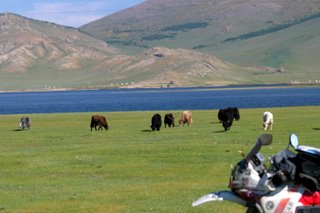
[One of our first views of Mongolia]


Unbelievable, these are actually getting shorter, and we are catching up.
This entry covers our trip from Mongolia to Russia, Kazakhstan, Kyrgyzstan, China and ending here in Pakistan shortly before we take off to India. Enjoy (or have a nice snooze!!)
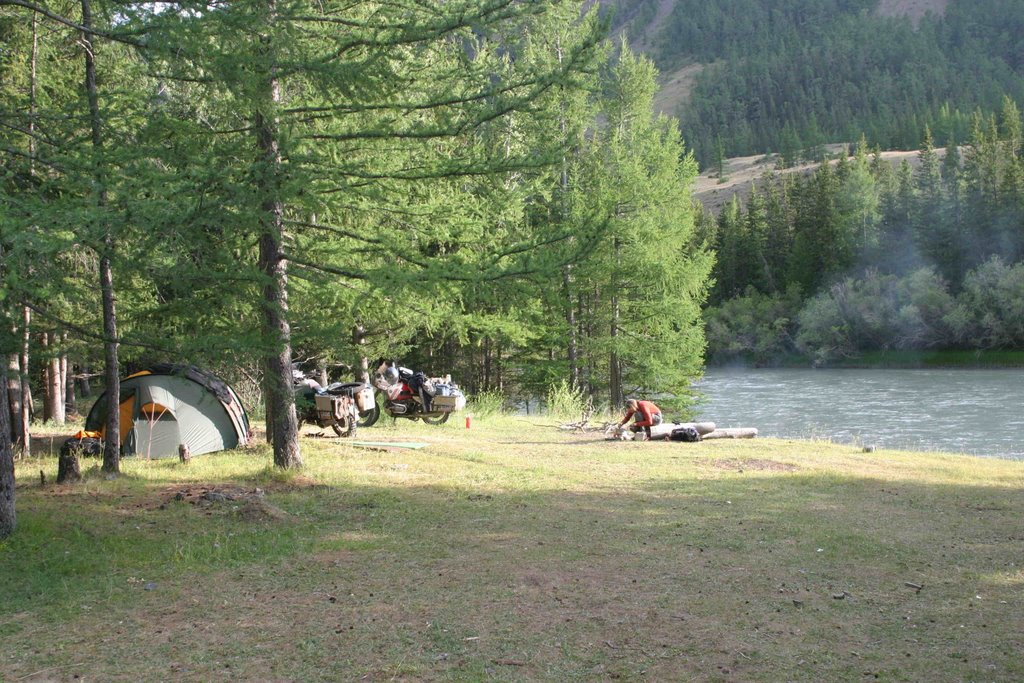
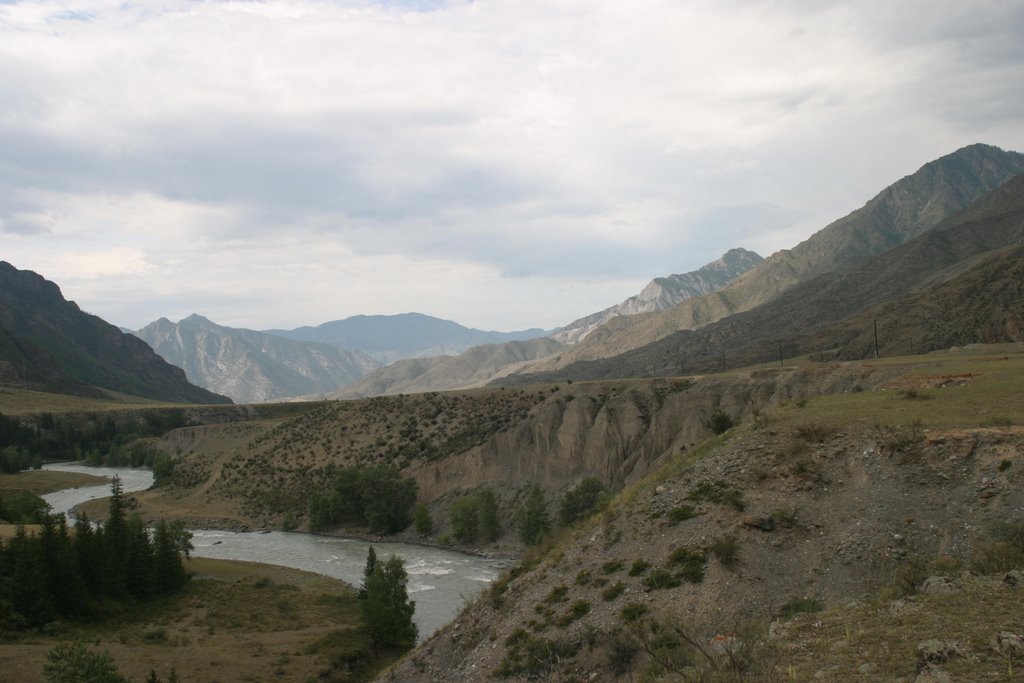
From Novosibirsk we headed toward the border of Mongolia at Tashanta in the Altai region of eastern Russia. Shortly after passing Barnaul the country started getting much more interesting than previously. First, it started going along a large river, second, this is where everyone from this part of the country comes on the weekends. There is mountain climbing, river rafting, and plenty of trails for mountain bikes and walking (at least based on all the people with various signs we saw everywhere). As it was Sunday, there was a huge amount of traffic headed in the opposite direction, for which we were thankful. The further we rode into this huge river valley the nicer it became. We rode until dusk and then found a little side road and camped near a small brook, appropriated the campfire which was still smoldering and settled down for the night. The following day turned out to be more of the same. The river got wilder, and we caught an occasional glimpse of a raft floating down the river. At the end, it opens up into a wide plain around 70 km long which ends up at the border to Mongolia. Since it was late we chose to stay in the protected river valley as the wind had picked up and it looked like rain. So another night camping next to this beautiful river, life could be worse.
Finally, the next morning we got to the Russian border checkpoint, and although there were only two other people there we were told to wait. After an hour we were told they were closing for lunch and would resume work in 2 hours. (Note that in that hour no-one had come or gone into our out of the Russian immigration!!!) So we also settled down for lunch. Sure enough two hours later we were let into the compound to start our paperwork (to get out of Russia). The Russian side of the border (Tashanta) would turn out to be the most inefficient border crossing, though not the most complicated, this still belonged to the Turkmenistanis. While doing the paperwork, the heavens opened up and we had a torrential rain storm, luckily for us the Russians were so slow, or we would be getting wet outside. In the end we managed to fulfill all requirements to leave the country and were let go. We now rode 26 km or so to the outer Russian checkpoint, where someone else checked our passports again, before finally allowing out of the country. Next was the Mongolian immigration. The whole place was empty, and in around 15 minutes we were welcomed into Mongolia. Simple easy efficient, a real pleasure.
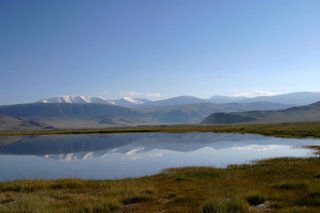
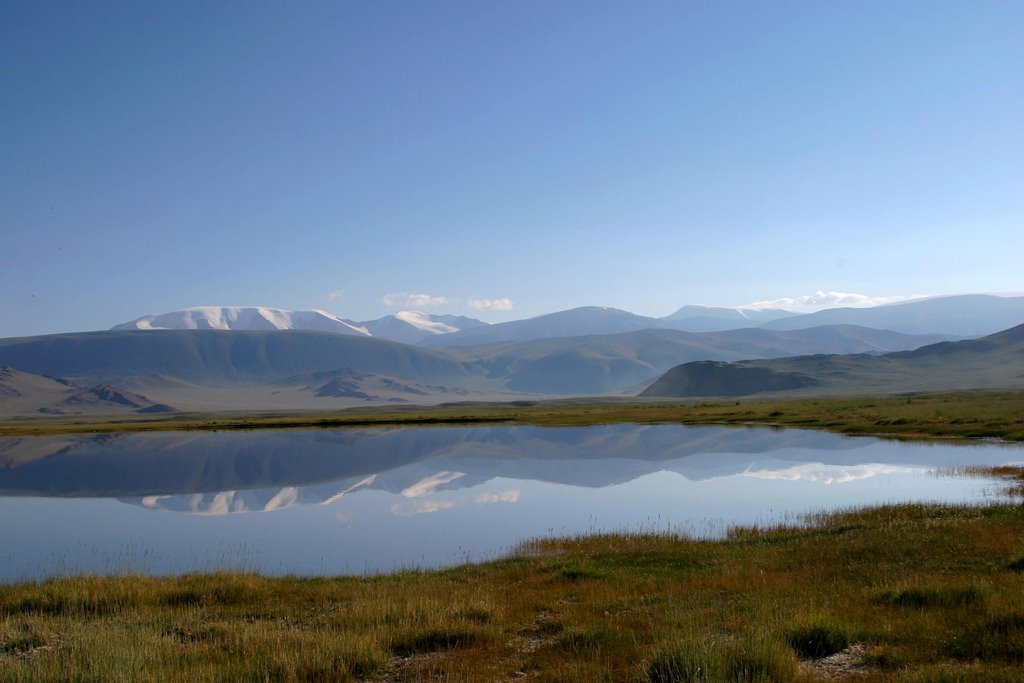
[Another "average" vista in Mongolia]


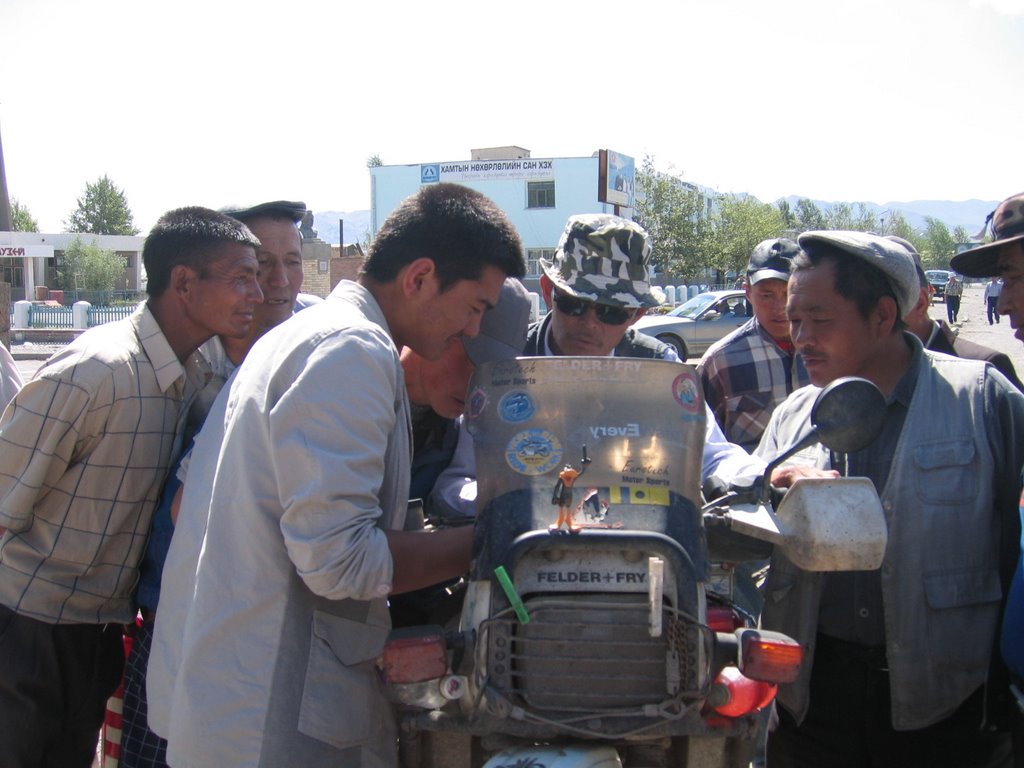
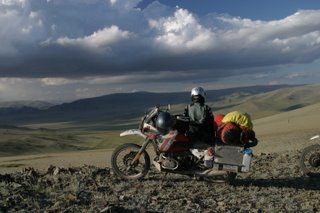
Mongolia did not disappoint. We had seen pictures, and they did not compare favorably. The vistas are huge, no roads, no signs, people so friendly it was scary. For example, we stopped a few kilometers inside Mongolia to put our papers away and get a drink, and a local bus (4x4 Russian van) stopped. Everyone got out, everyone shook our hands and welcomed us to Mongolia, thrusting babies in our arms!! The Mongolians like to look at everything with their hands, and this took a while to get used to. Everyone always alternatively smiling and shaking their heads at these huge bikes and riders. Lovely. Similar episodes would punctuate our whole stay in Mongolia.
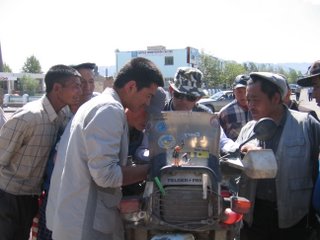
[The Mongolians are a curious, hand-on bunch.]


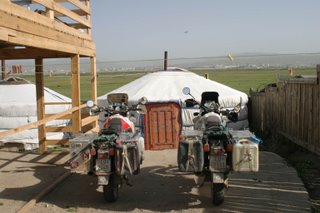
Sitting here in Islamabad, trying to think of something about Mongolia which sounds good on paper is difficult. I have to say Mongolia is primarily a visual experience. For people used to cities and confined spaces I recommend they stay home. If Mongolia is anything it is a huge open space, punctuated here and there with small villages and occasional GER camps (Ger's are the Mongolian traditional tents, called Yurts in other places).
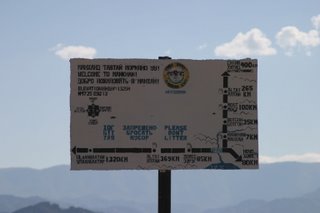

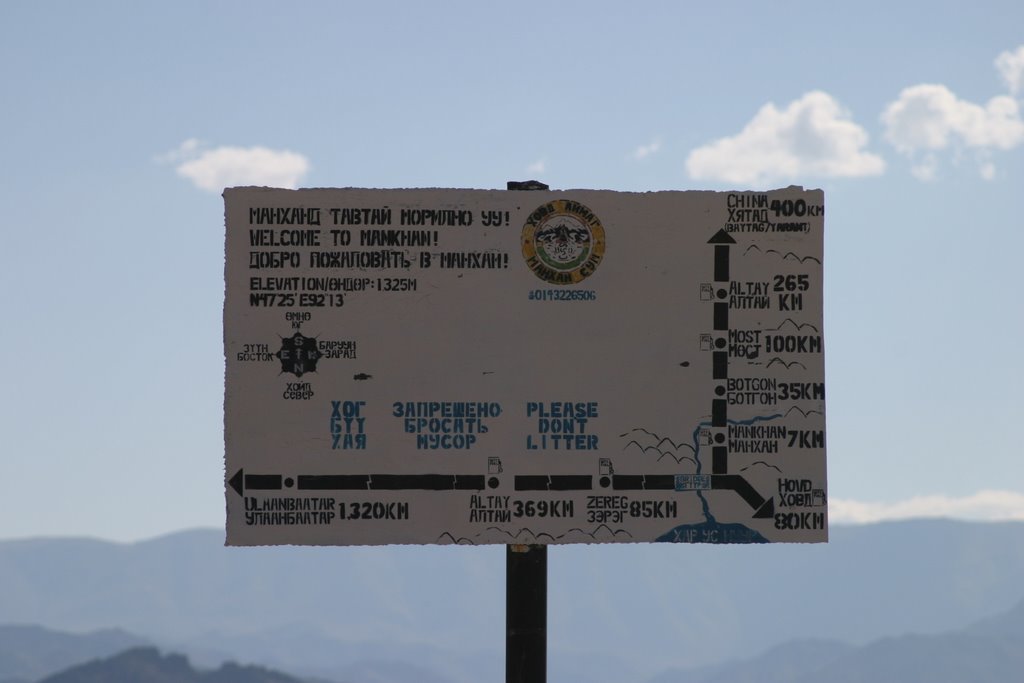
[One of the few traffic signs in Mongolia]


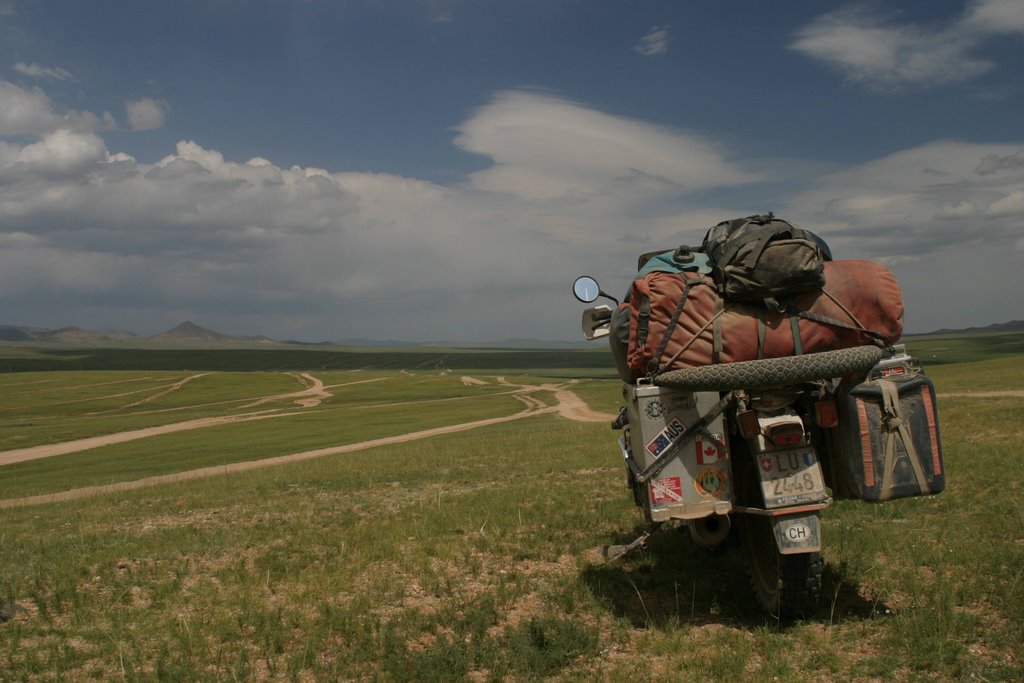
[Typical track choice, Mongolia]


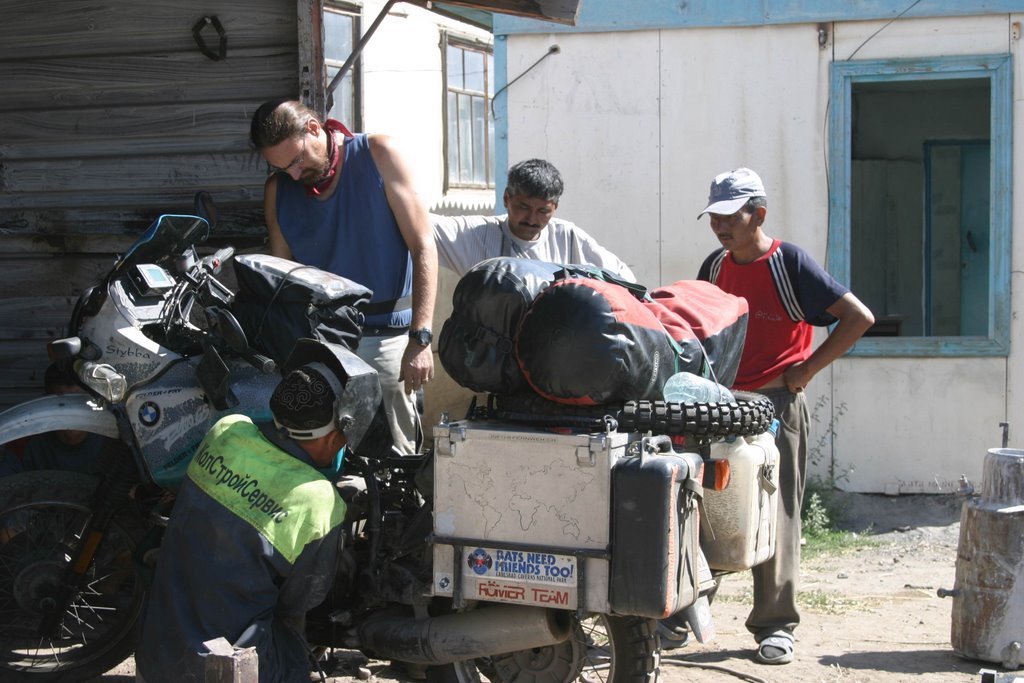
There are no signs (almost), and no real roads anywhere outside the major agglomerations (of which there are only a few). So one basically just strikes out in the particular directions one wishes and if this track eventually goes over a pass it will converge with others as there is often only one that goes over the passes. On the other side, the paths will again diverge as everyone chooses a different way of crossing the wide plains separating the various mountains or hills. This goes on for thousands of kilometers! It took us 8 days to get from the border to Ulaan Bataar the capital. In this time the frame broke on Cecilia's bike twice, along with further breaks to the luggage racks of both bikes. All minor repairs by my standard. In the next settlement we would seek out a welder and he would then repair the broken part, the cost usually around 4-5$, and we would continue on our way.


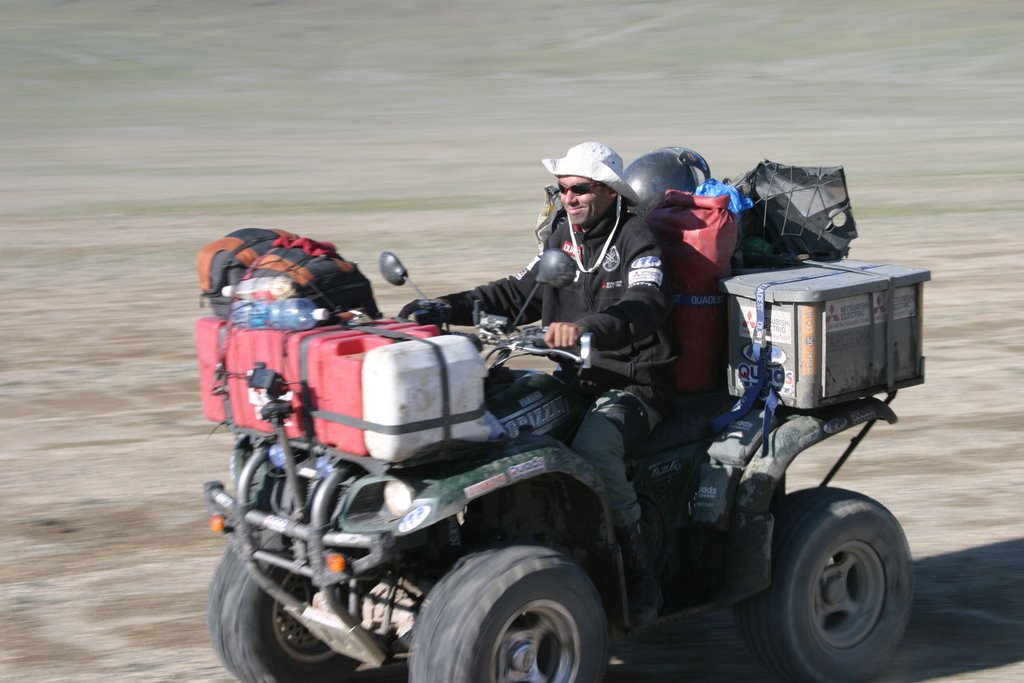
[A Spaniard on a 4x4 quad racing across the Mongolian stepp, what a sight!]


The route we choose to take to Ulaan Bataar is known as the southern route, and basically is long, flat, and empty. There are no trees only huge low valleys, and plains, plenty of sheep, some camels, and horses (by the way we are at around 2000 meters for much of this part of the country). The track is lots of sand, corrugation, dust, and rocks, broken up by a few water crossings, and an occasional low pass or two. Day in day out same, same. Sounds boring, but it was really beautiful. One of the strangest things we came across was a 100 km or so outside of Ulaan Bataar, as we came over a rise, we were greeted by the sight of hundreds of Gers and tents, usually next to piles of rubble. This across the major "path" which went across the valley. Everyone was digging for gold!! They just set up their Gers and started digging, and this for an area of one square kilometer. Really strange. We had to detour around all the activity and continued on our way.
Ulaan Bataar was a very surreal experience, after all the empty spaces. It is a large city, with the accompanying traffic, noise and people. We had come here because we required a visa to re-enter Kazakhstan on our way south, the visa for Russia was multi-entry so that wasn't a problem, but Kazakhstan multi-entry visa was too costly and difficult to obtain. So we choose to do it this way. We also had a contact for a place to stay in Ulaan Bataar, and we were also expecting a packet sent from Switzerland with spare parts to come to that address.
We had a telephone number for our "contact", a certain Sabine, who runs a "biker guesthouse" in the capital. Well, as luck would have it, Cecilia's cell phone couldn't place calls here, so we tried by having a friendly bank teller call the number for us. The result was that the person on the other end said that Sabine was not there and would return in 10 days!! Unfortunately we didn't get to talk to the person on the other end, and the teller only said he didn't speak English anyway. We simply didn't get any further with her so we had to find another way. First we decided to check out some of the other guesthouses, all were full, or we couldn't find them. Then I bought a local SIM card for my mobile and we called the number again. The person really didn't speak very much English, but with a little effort we managed to confirm the address and we then had a taxi driver take us to the address in question.
This is where the fun begins, first near the address, I called again and the taxi driver spoke directly with the other party to get the correct directions. The address was quite a ways out of town, and for a while I was wondering what was going on. In the end we ended up in front of a gate with a little sign which showed it to be Sabine's guesthouse, and Oneway limited (a company name). So it seems we where in the right place (by the way the co-ordinates are "N 47° 52' 32.7", E 106° 49' 54.3", all co-ordinates will be posted on our web page when I do the update). I pay the taxi driver, he takes off. We honk our horns, knock on the gate, wait. Knock some more no answer. Eventually a lady comes walking by, opens the gate and lets us in. I follow her into the house, and there to my great surprise I find a gentleman passed out drunk on the floor, with a toddler in his arms! The woman, picks the baby up, kicks the guy a few times, he just turns over and continues to sleep. I feel like I am in the twilight zone! This can't be the guy I have been talking to (or trying to). So I call the number, sure enough someone else answers, and I explain that I am "Here". He says good, he will come by tomorrow! What? No, come by now, and straighten this mess out. I tried to explain that there is a drunk on the floor, the lady doesn't speak any English. So I hand the phone to the lady, she speaks with the guy for a few minutes and I get the phone back. No problem he says and hangs up. OK. This is getting better by the minute. Cecilia is still outside the gate waiting to see what is what.
The lady who let us in finds some keys and beckons me outside where she opens one of the Gers and shows me inside. OK, so we have a place to stay. I get Cecilia and we get our bikes inside and start unpacking. The lady asks if we want some food, so I said sure, and she runs off into the kitchen and prepares dinner, while Cecilia and I get unpacked and set up.
A half hour later a car pulls up and it is the guy on the phone. It turns out that he is a local fireman, and is on duty which is why he couldn't come before. He is a friend of Sabine's and therefore has her mobile. He says (it is a lot easier to communicate person to person), that she is gone. He doesn't know anything about the package we had sent here. He has to go back to work so he checks that everything is OK with the Ger and the food and then leaves. In the meanwhile the drunk is on his feet (barely), and speaks a few words of German to us, and disappears again. We have a dinner (some rice with meat and tea), and retire for the night.
The next morning there is no lady, no drunk, the baby is still there, but there are two young women taking care of it. They ask if we want breakfast and are promptly served fresh fried bread and butter, jam, eggs and tea on a nice sun terrace from which we have a nice view over the river which runs in front of Ulaan Bataar and the city in the background. The previous night seemed like a dream.
We end up staying nearly a week here, it is a terrible place to be if you have no transport, as it is around 14 km from the city center. But with the bike it is no problem. We get our visa, do some minor work on the bikes and relax for a few days before heading back toward the border to Russia. It has already been two weeks since we came into the country! While in UB we meet a German couple who are waiting for parts (we were able to pick our up at the TNT office in the city, no problem) from Germany. So for a few days we meet them for dinner every evening and swap travel stories.
We decide to take the northern route out of the country and so finally get on the road and head in that direction. The northern route turned out to be delightful. The tracks are better and there is a lot more scenery. Rivers, lakes, trees as well as the usual plains and plenty of empty spaces of course. As we were not in a hurry we spent a few days at a lake in northern Mongolia called Hovsgul Nuur. Absolutely gorgeous. Very difficult to get to, in particular the western side of the lake, but once there very relaxing and scenic. While camped there we were treated to some great Yak yogurt (add some sugar and jam) by a local from a nearby Ger.
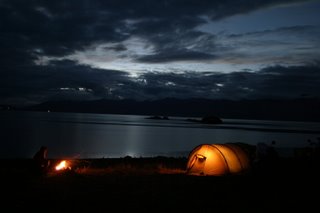

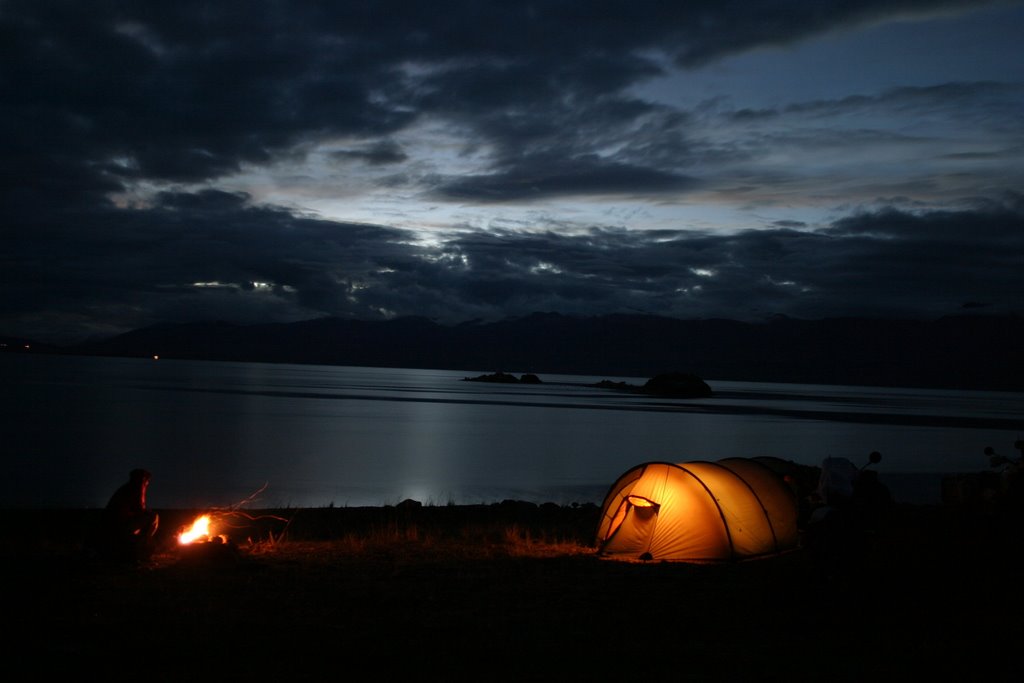
[Camping on Lake Uureg Nuur in North West Mongolia]


Uureg Nuur another lake in the north western part of the country was also absolutely gorgeous, we almost couldn't tear ourselves away. But as life would have it, it started to get pretty chilly at night and even during the day the wind was blowing pretty cold from the north. It was time to head south.
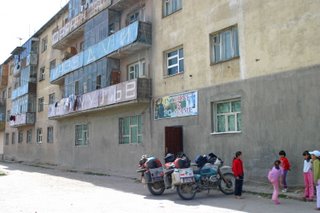

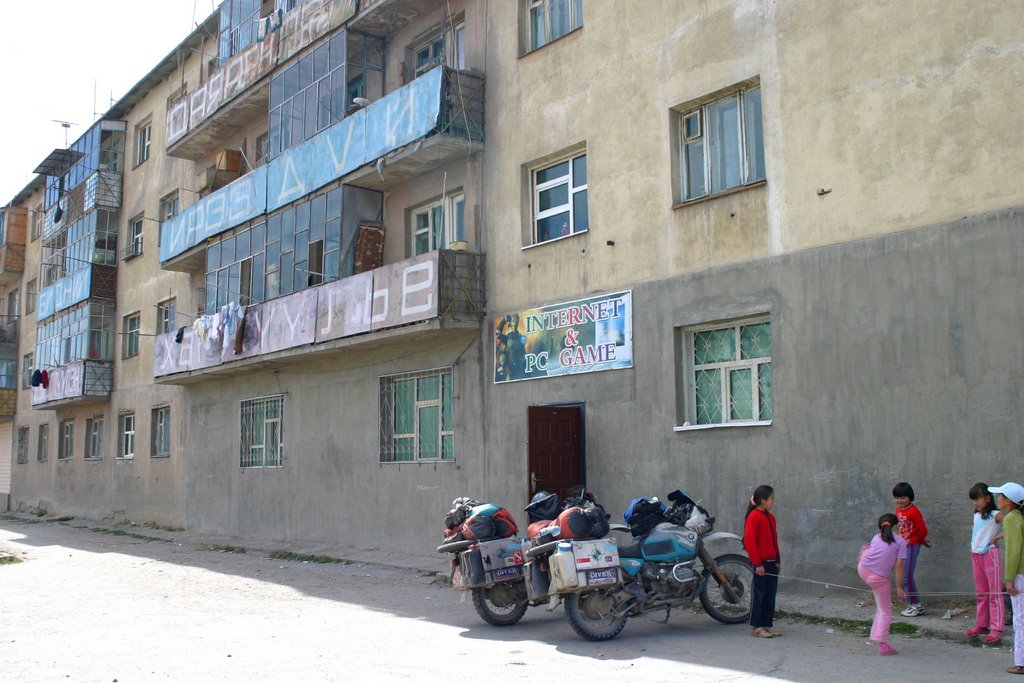
[Internet stop in Oelgy, Western Mongolia]


In Olgy we picked up some supplies and did some things on the internet, and also ran into a troupe of Swedes coming from South Korea on their way to Sweden. They were on a Tran-Asia tour and were quite a sight to see. Around 8 bikes and 2 jeeps. We would run into them the following day again at the border, but on this day they were just wandering around Olgy looking for a hot shower. (Which they found in the local bathhouse). We headed toward the border and camped as near as we could, so that we could get an early start the following morning.
This is the same border we crossed previously and so were prepared for the slow pace. Unfortunately, as it was Monday (the border is closed on the weekend), there was more traffic that we anticipated. It took nearly an hour to get into the Mongolian immigration, which as previously was very efficient and quick, in 20 minutes we were on our way to the outer Russian border checkpoint. There things got slow very quick. As we parked, it became clear that the Russians had only let one or two of the vehicles go across that had come today (it was almost 10:30)so the rest were parked here. There was no movement one way or the other. Around 11:00 we were told that they were closing for lunch, so we had to wait until 14:00. At a quarter to 3 there still wasn't anything going on. Then the Swedes arrived, all at once. Together with the Swedes Cecilia managed to get the Russians to let us through, but not before they had turned all the Mongolians and Kazakhstanis away, so 20-30 cars and busses, many full of students going back to school in Kazakhstan all turned around and only the bikes and the two accompanying vehicles were allowed through for that day!! (4 Russian trucks had also been allowed through, but no other vehicles as long as we had been there, and only 2 had come in the opposite direction). The explanation was that there had been too many people coming through from the other side to process everyone!! Something which we were to find out wasn't the case. We all rode through and at the immigration stations (a brand new building, full of functionaries who didn't seem to busy as there was only 3-4 people there!!) we were given the full dose of bureaucracy, from having our vehicles disinfected, and having to purchase new insurance (our old one had lapsed). All of which took nearly two hours, including fighting about the fact that the insurance cost double what I had paid when coming in from Kazakhstan. But we finally got back into Russia, and headed straight for our last campsite here, which was just as pristine as we left it. The Swedes were behind us and as they were a large group it probably took them quite a while longer than us. But in the end it is remarkable how little they manage to get done at this border, whether by design or otherwise it is hard to tell, as the other two Russian borders were speedy by comparison.
Back in Russia, the plan was to go to Novosibirsk to pick up tires we had been able to order from BMW Moscow and were being shipped to the dealer in Novosibirsk. We took care of this, this time staying in a different hotel which was much nicer, but cost around the same. The tires where there and we took them to a local bike shop to get them mounted and continued on our way. As soon as we left the Altai region it had started to rain, and was cold, so we were riding in the rain to and from Novosibirsk, and very glad to be leaving this part of the world for hopefully warmer weather.

Kazakhstan didn't disappoint. As we neared the border, the weather cleared. The Russian and Kazakhstan immigration and customs were both efficient and relatively speedy and we were back in Kazakhstan. Same vistas, flat plains as far as the eye could see, but the weather was getting warmer. By the time we got to Almaty, all the cold weather gear had been stowed and we were back in our summer riding gear.
In Almaty we got a nice little apartment for a few days while I did some maintenance on the bikes. I also had to get some work done at the local bike shop, all of which was taken care of fairly quickly. This in addition to getting the visas we required for Kyrgyzstan and Pakistan, was all that we needed to do in Almaty, so we continued as soon as it was done.
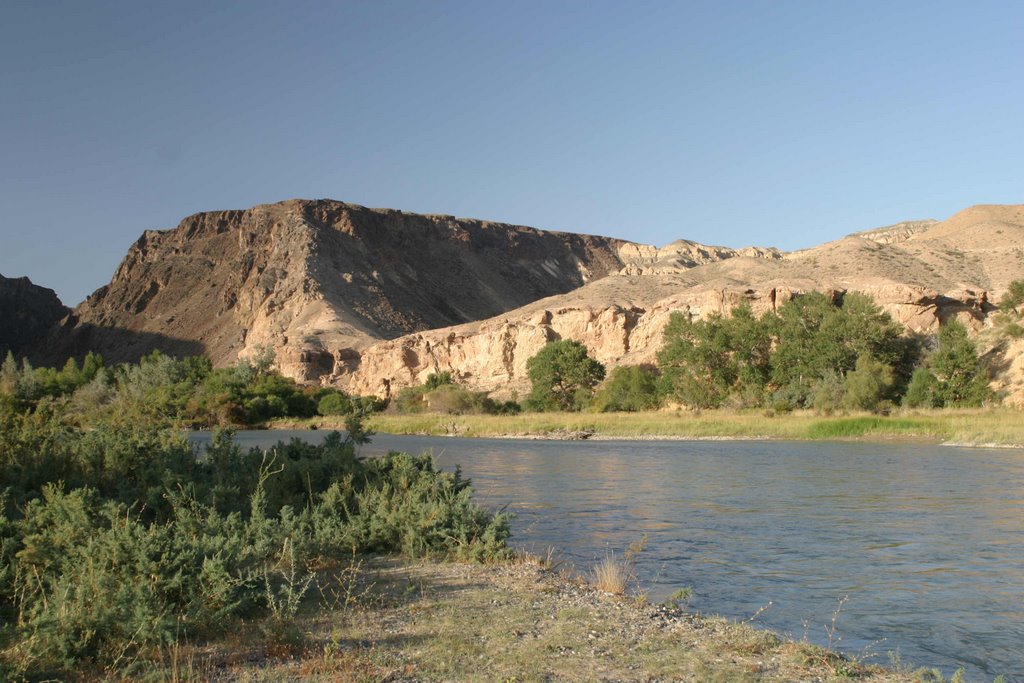
As we headed for the Kyrgyzstan border we came across a very nice river valley where we camped for the night. The only time I can recall in Kazakhstan, that the landscape showed any "promise".
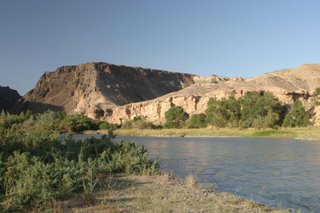

[River Canyon, Kazakhstan]


The following day (a Sunday) we crossed from Kazakhstan to Kyrgyzstan across what had to be the easiest least problematic border I have ever seen (barring none). Both sides took a total of 5 minutes, no customs docs, nothing, and there wasn't a soul there. This is the border between Kegen (Kaz) and Karakol (Kyr), so a very small and little used border post. As we approached I thought it might be closed, but a guard on each side took care of everything.
Kyrgyzstan turned out to be a real gem. Beautiful vistas, very friendly people, and some excellent (MC) roads. The first night we spent at the Karakol Tourist camp in a "traditional" (tourist) Kyrgyzstan yurt. Cute, but the camp was really nice. All around the vistas had one mountain higher than the other, all covered with snow. We spent the next couple of days making our way toward the Chinese border with a couple of side trips along Lake Issyk-Kul, and Song Köl, both very scenic areas. Lake Issyk-Kul is a major tourist attraction (at least during the soviet era, now mostly abandoned, but slowly being rediscovered by western tourists who mostly come here for the mountain trekking), not to mention that it was a testing ground for submarines during the cold war. Song Köl is way up, at 3000 meters a very high alpine lake. The northern shore nearly deserted, and perfect for some beautiful lakeside camping. To some extent we almost felt we were back in Mongolia. The vistas not quite as empty or large, but very similar.
We spent our last night in Kyrgyzstan in a real Yurt near the old Caravan fort of Tash Rabat near the border to China. This was also a stop on the silk road, and is situated in a narrow valley which if followed up will end up on a very high plain along the Chinese border. The family we stayed with was extremely hospitable and the yurt very comfortable. One day I hope to come back here and spend more time, but we have to get to the border as there will be a guide waiting for us on the other side.
The following morning we made our way to the border. Before the first checkpoint, my motorcycle celebrated a momentous occasion, it turned over 300,000 km, so I stopped and took a picture.
The border was un-eventful. The Kyrgyzstan side only had a small objection to the fact that we had no Fax as invitation to enter China. They are aware of regulations that foreigners with their own visitors require a guide on the Chinese side, and want to make sure that they don't have to re-process anyone that gets turned back. We showed them our e-mail invitation and they let us pass. At the top of the Torugart we had to wait around 40 minutes for the Chinese guide before being allowed to pass. The road up here (3700 m) was pretty bad as lots of Chinese trucks use this route. The Kyrgyzstan side isn't too scenic, when compared to say, Tash Rabat, but as soon as you get over the pass to the Chinese side, it gets very interesting. The mountains rise up dramatically on both sides, and the road is a lot steeper than on the Kyrgyzstan side. A few km later we stop at the first customs checkpoint on the Chinese side, here all our luggage is x-rayed. We then put the luggage in the guides car and continue along a very long, wide and wild. If the road had been better it would have been a really enjoyable ride, as it was we had to concentrate very hard on the road. Nevertheless it was a lot of fun.
At the bottom we finally hit the Chinese immigration point, where the Chinese were very efficient and friendly and it only took us 20 minutes or so to get through. We received new drivers licenses, and motorcycle papers, as well as license plates, all in Chinese. There were some additional customs formalities which our guide(s) took care of, we just waited outside, a real luxury.
From here we then drove the last 60 km to Kashgar where the guide dropped us off at a nice hotel and left.
We were now in China, OK maybe not quite, this is the Xianjing province, which is actually used to have a minority of Han people, until the central government started importing them en mass. Our guide admitted that he spoke practically no Chinese (Mandarin) and has to take courses. The people on the street are a mix of Kyrgyzstan, Mongolian, Chinese, Russian, a truly interesting mix. All as it should be for one of the greatest trading centers of the old (and new) silk roads. At the core though, it is a large city, with the few interesting things hidden away in the old town, or residential areas, which Cecilia took a quick look at. I simply enjoyed the ambiances of a very large, and varied mix of people.
After three days it was time to move on to Pakistan, with a quick stop at Karakul lake and in Tash Kurgan, where the Chinese immigration is. Compared to the lakes we had enjoyed in Mongolia and Kyrgyzstan, Karakul was just a tourist trap, not worth the effort or cost. Keep going and just around the corner is a group of Yurts, where you are welcomed to stay and are treated to a real authentic slice of life in this part of the world. The family simply vacates their Yurt and stays with the neighbors while you get to sleep in theirs. They feed you and you get to spend a few hours appreciating how hard and simple their lifestyle is. A real treat.
The following day, we headed to Tash Kurgan, via a little side trip. The Karakorum highway goes over a 4000 meter pass near a glacier, here it is possible to take a jeep track to where the glacier is coming down the side of the mountain. Something we decided to do. We made it up to around 4529 meters, where the jeep couldn't make it over a steep incline, and we decided it wasn't worth trying it on the bikes either. So we parked, and Cecilia and the guides walked the remaining 150 (vertical) meters to the face of the glacier at the bottom of the mountain!! Keep in mind the highest mountain in Europe is Mt. Blanc at around 4800 meters! Here the mountain started at that hight. The mountain in question was around 7700 meters, so it towered above where we were. Really spectacular. The bikes had very little power at this altitude, but they ran, with no modifications whatsoever. Dirty air filters, carburetors out of adjustment, valves not properly set. It is a real testament to German engineering that they didn't have any problems. My attitude was ride them 'till they drop, then I will fix whatever that is wrong. Luckily I didn't have to do anything.
We reached Tash Kurgan and settled in the hotel for the night, with a little side trip to a local welder to weld a broken box frame, a 5 minute job, costing a total of 1.50$. The following morning we went to the Chinese immigration and took care of the exit formalities. The efficiency and thoroughness, meant that it was very slow, but of course nothing compared to Tashanta or Turkmenistan! So after 3 1/2 hours we were on our way. No more Chinese license plates, but we got to keep our licenses and various other documentation as souvenirs. The actual border to Pakistan was another 200 km further on along the Karakorum Highway. The road here absolutely perfect, totally flat, and for the most part pretty straight, as it runs through a very wide valley floor toward the Kunjerab pass. Along the way we got to glimpse the famous K2 mountain just off to our port side (left) as we were climbing up to 4700 meters where the pass is. Luckily for us it was a beautiful day and we got a great look at all the mountains around us. After two more quick checkpoints we were at the top of Kunjerab and in Pakistan. The lone guard here is just for looks, as all the formalities are taken care of many km further down in the valley.
The Pakistan side was even more dramatic than the Chinese side of the Torugart pass, here the carved the road out of the side of the mountain, and it continually tried to reclaim its territory. An unbelievable feat of engineering, and than a couple of hundred kilometers long. Incredible, you could practically touch the other side of the valley. Lucky for us the road went down, down, down, if we had to come up this way, our bikes would have had a much harder time than on the Chinese side, which climbs very gradually.
On the Pakistani side, we were constantly passing Chinese work crews, we were to later find out that they are here to help Pakistan build a new two lane (or was it four lane) KKH. How they plan on doing that I don't know, but it will be interesting to see. Last year the KKH was blocked in more than 100 places, and this year it was blocked for more than a month due to heavy rains. So they really have their work cut out for them.
After clearing immigration and customs we proceeded to Passu where we had a good tip about camping at a place called Glacier Breeze Restaurant and Camp. It turned out to be better than even the most enthusiastic recommendations. We spent the next two days stuffing ourselves and getting a serious pampering from the staff. When we left the bill totaled 78.- Sfr for camping, dinner, breakfast, snacks, etc. over 4 days!! This included some of the best food we have had in a long time, highly recommended.
While here we ran into a group of Germans taking part in a guided overland tour from Germany. They were heading up the Karakorum to the summit, and then back toward Islamabad where they had been previously. The convoy included 4 all terrain trucks and 3 motorcycles, a very strange sight on the roads of Pakistan. We then headed to Karimabad where we spent a day checking out the Balti fort at the top of town, and some of the amazing water channels that have been cut into the side of the mountain to harness the water coming down from the mountain, miles away from the source. We also "discovered" the Hunza Cafe, and the Walnut cake (something which the Germans had told us about back in Passu), which is excellent. It should be it is based a Swiss recipe, namely the Engadiner nüsstorte!! This is not just idle boasting, the proprietor told us so. As part of a local help project, a Swiss development agency taught him how to make the cake, and run a small bookstore, and most important how to make a decent cappuccino! Now that is real development help!!
From Karimabad we continued on the KKH ran into our German friends at the Panorama hotel in Chilas. The following morning one decided to tag along with us to Bescham, the next stop along the KKH. We enjoyed wonderful weather, and the road continued to throw vistas at us, which just left us breathless. Every town we passed seemed more chaotic than the next, and the amount of colorful trucks we passed continued to increase. In Bescham we settled in at the Rana Inn, which filled up with these huge trucks later in the afternoon. The local population seemed to find it also very fascinating, as they camped outside and kept an eye on the happenings, now who was in a cage?
The following morning, we let the trucks and everyone leave while we had a leisurely breakfast and got on the road. More and more traffic, more and more towns, always larger than the previous greeted us as we made our way toward Islamabad. Then 20 km north of Manshera in the hills with some great curvy roads, albeit, very slippery and lots of truck traffic. Cecilia's bike slid out from under her when trying to avoid a truck which was in the wrong lane around a corner, and ended up broadsiding the truck. Luckily they were both going very slow and she didn't get hurt. The bike was another story. The front forks were bent, and bike was un-ridable. Again, as luck would have it, we had just passed the German trucks, and one had a trailer, so when they caught up with us a few minutes later, they offered to take the bike on the truck to Islamabad, which we gladly accepted. I bid farewell to the truck driver, no harm done, there was no point in getting into an argument, or getting the police. These guys have no money and there would have been a lot of hassle involved. We packed everything on the truck and Cecilia rode in one of the trucks and we continued. The rest of the ride was memorable only for the heavy traffic, lack of road rules, and the fact that my clutch cable snapped two kilometers from the campground. After ruining one spare cable, I managed to get the second one to fit, and made it to the campground just after the trucks overtook us again.
We set up and basically went to bed, it had been a pretty bad day all around, but in the end only the bike had gotten hurt and we were all thankful for that.
The following morning we decided to go an apply for our Indian visas first as this would take some time to process, during which I could get to work on the bike. So that is what we did. The procedure in Islamabad is pretty convoluted, but we managed. Basically, you have to go to the Coliseum and take a shuttle bus to the diplomatic compound, as they don't let you in any other way. All security measures are done before boarding the bus, no electronic gadgets, mobiles etc., all in all a pretty thorough check. We applied for our visas and then went to the bank to see about getting money. But by now it was near noon, and the ATM was empty, they advised us to come later or in the morning. We then headed back to the camping.
The following three days I spent taking the bike apart, and getting the parts fixed as well as could be done. I found a machine shop who was able to bend the forks back and in the end they were straight again. Also a number of additional parts had to be straightened. When I finally got everything done, and started to re-assemble the machine it turned out that the upper fork bridge was also damaged, so another day was wasted getting this fixed and installed again. By Sunday everything had been done and the bike was running again. A test ride showed that the handlebar was still a bit bent, but usable. The following day then we did another longer test ride and Cecilia declared that we could continue to Goa this way.
That brings us to the end of this "longish" blog entry. We are now set to continue our trip. We will pick up our visa and the following day head to Lahore, and then the border to India. In India we are planning on heading south as quickly as possible, leaving the sightseeing for after a month long beach vacation. During this "vacation" I will update our web page and add lots of more details of our trips to the journal as well as the usual section of goodies, pictures, tracks etc. Stay tuned.
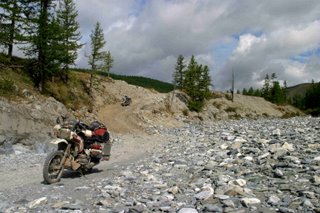

[Mongolia]


[Mongolia]


[Mongolia]


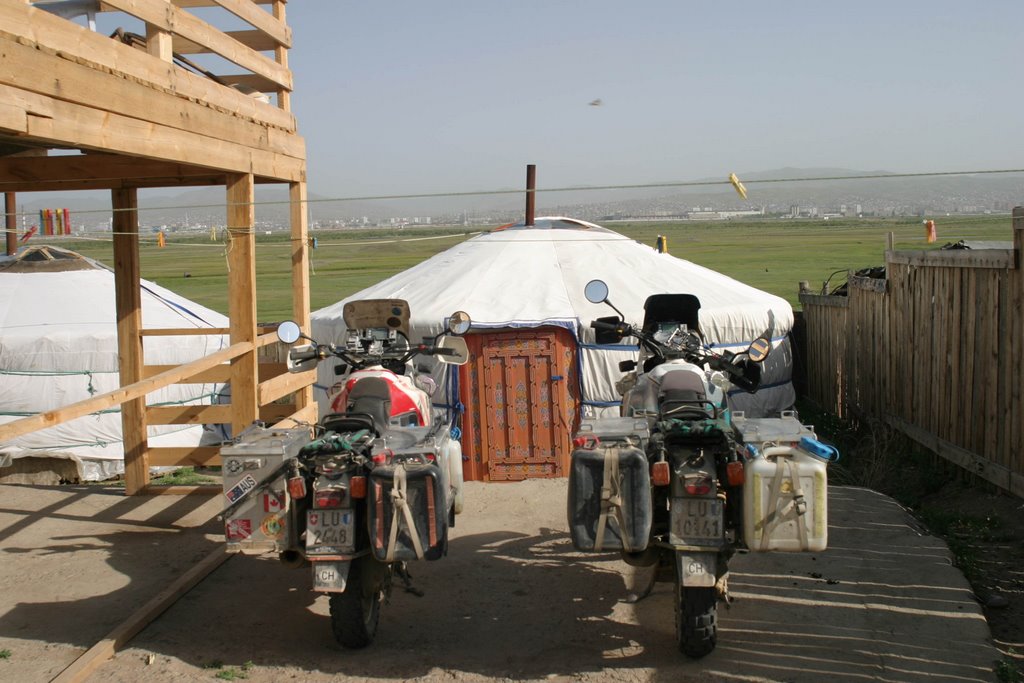
[Ger Camp just outside Ulaan Bataar, Mongolia]
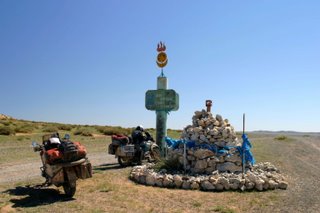


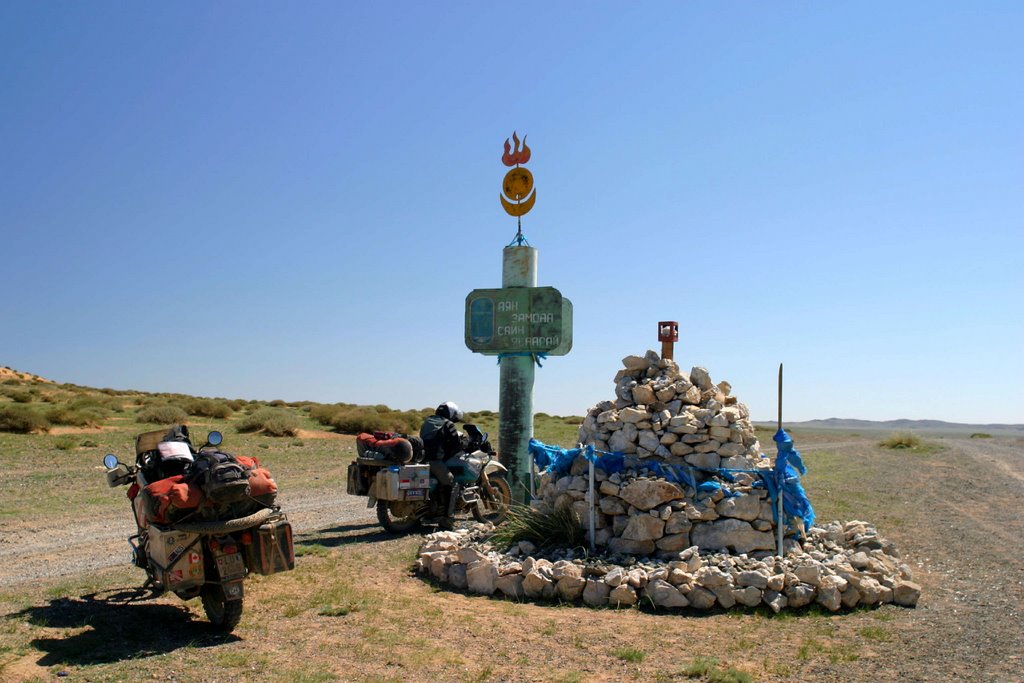
[Religious Cairn, Mongolia]
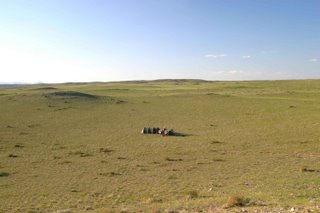


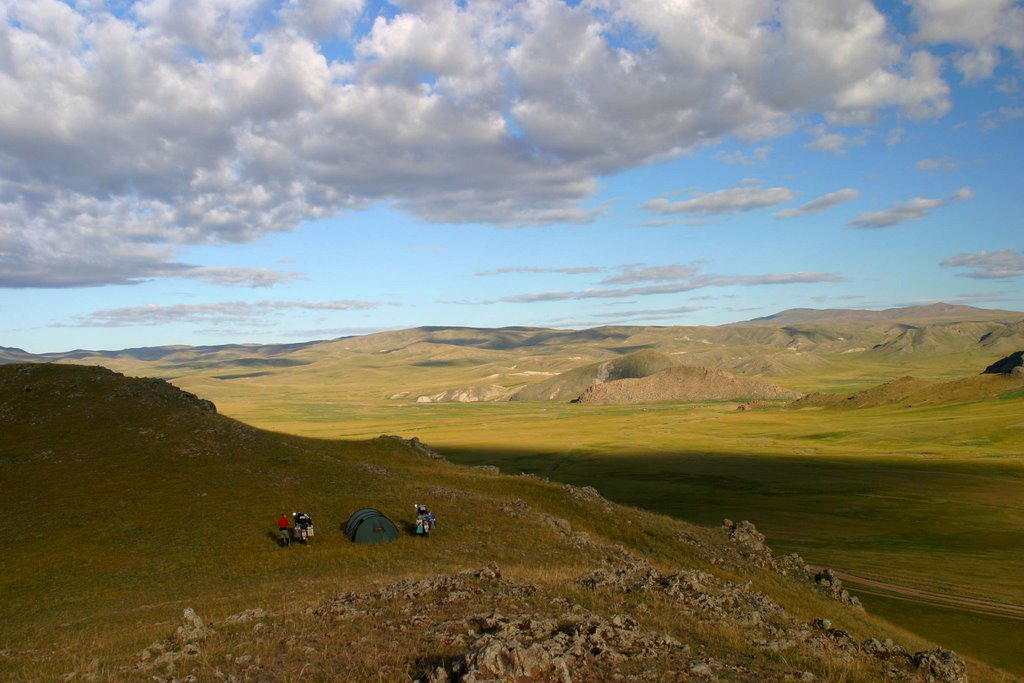
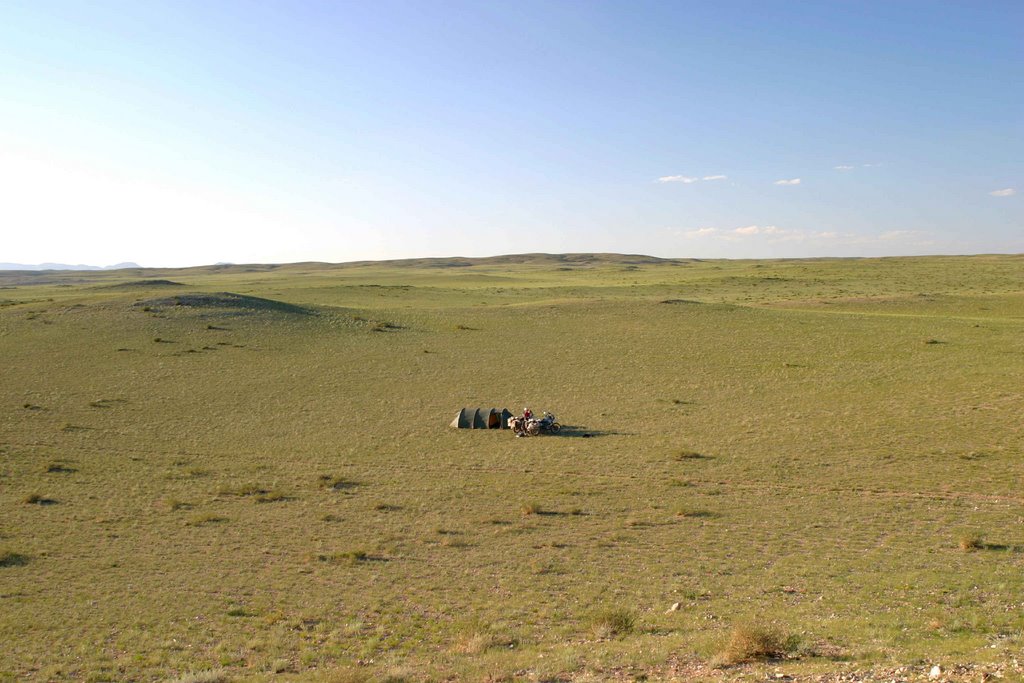
[Typical campsite, Mongolia]
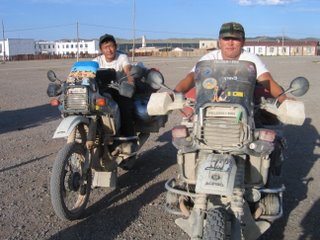


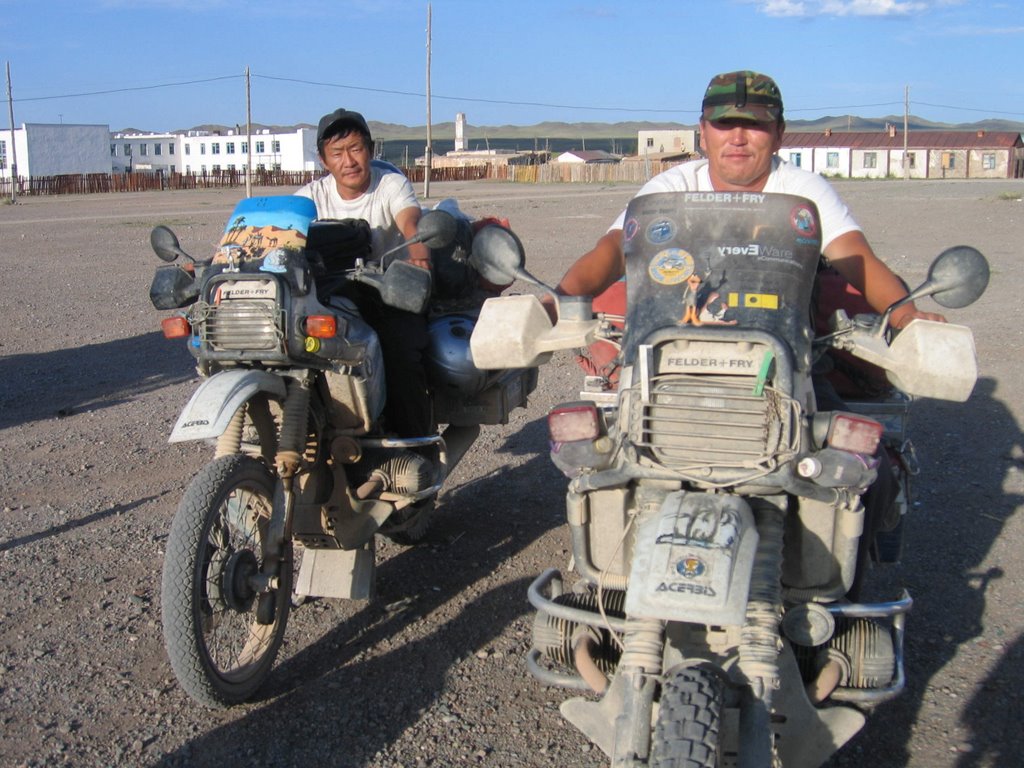
[Some more Mongolian "motocycle" fans]

Islamabad (Uzbekistan/Russia)


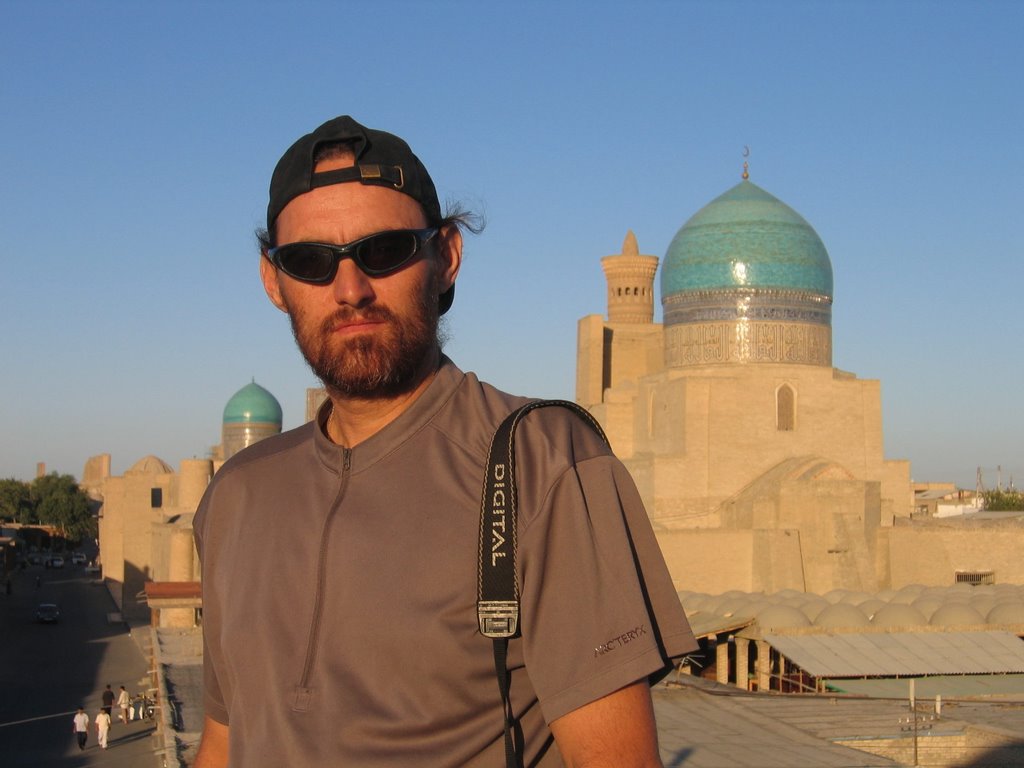
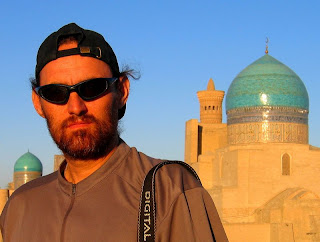
["I am smiling", Bukhara, Uzbekistan]


This blog entry will cover briefly our trip through Uzbekistan, Kazakhstan and Russia.
After Turkmenistan, the formalities in Uzbekistan were simple, and even after we were finished (30 min) we kept wondering if there was something else to take care of. The procedure consisted of filling out two customs declaration forms, getting the passport stamped, telling the doctor that there wasn't anything wrong with you. Driving 50 meters to customs and showing the paper to a clerk there who stamps it and you are done. Could hardly be simpler.
We then drove through wonderfully green fields full of melon to Bukhara. Where we were completely lost for a while, until a young man on a bicycle escorted us to the hotel we were looking for. The poor guy wanted to take shortcuts which we on the motorcycles couldn't do, so in the end he ended up going the "long" way around pedaling like furious followed by the two bikes. Pretty funny sight actually. The problem had been we had been very close to the hotel, but the area was a pedestrian zone, with a number of dead end streets all around. When we got to the hotel, the guy on the bicycle just continued pedaling, we didn't even get a chance to say thank you.
As we got off the bikes, a familiar face is staring at us from the rooftop terrace. Massimo was here! He had had an accident in northern Turkmenistan and had slightly hurt his foot, but otherwise had gotten here without incident. He was now headed to Tashkent to pick up his girlfriend who was going to be accompanying him back to Italy.


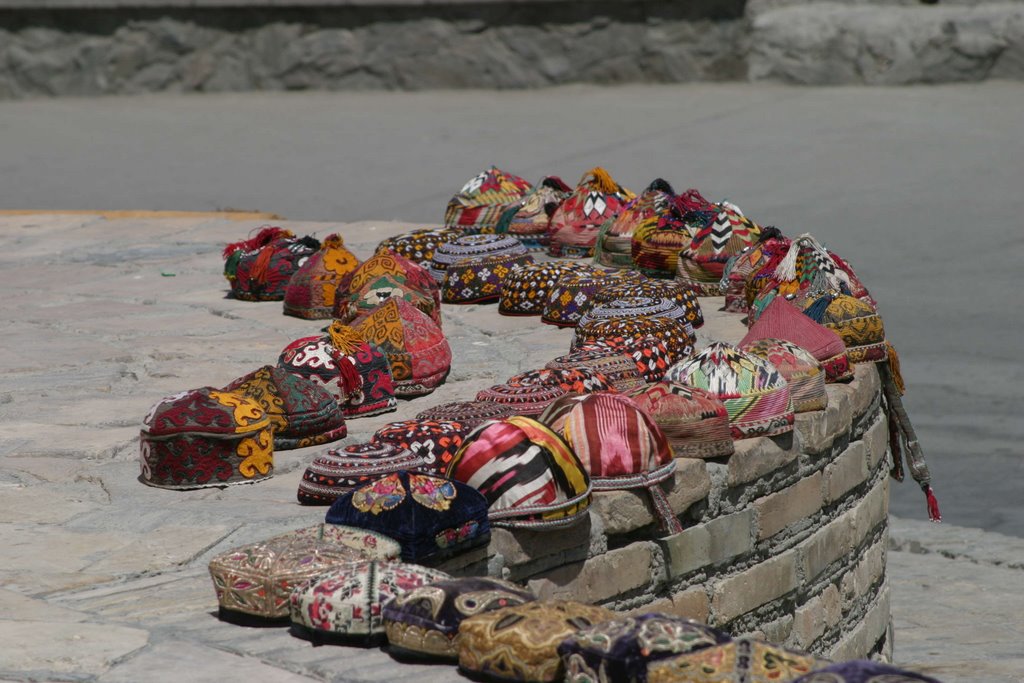
[Hats, Bukhara, Uzbekistan]


The following day after a leisurely breakfast and saying goodbye to Massimo we proceeded to visit some of the sights of Bukhara. My poor vocabulary can't really do justice to the sights here. They are simply incredible, from the Kalon Minaret, to the bazaars and various city quarters, your mouth is continually dropping with the grandeur and elegance of the various buildings. In particular the tile work here is some of the most beautiful I have seen anywhere. Some of the awe is surely inspired by our visit to Ashgabat, which had none of the charm or "soul" of what we witnessed here. There are justly many tourists here, but it doesn't feel overly touristy (at least outside of the bazaars!!), and as soon as you take a dip into some of the alleys and byways you are living history, as these alleys haven't changed in 400 years.


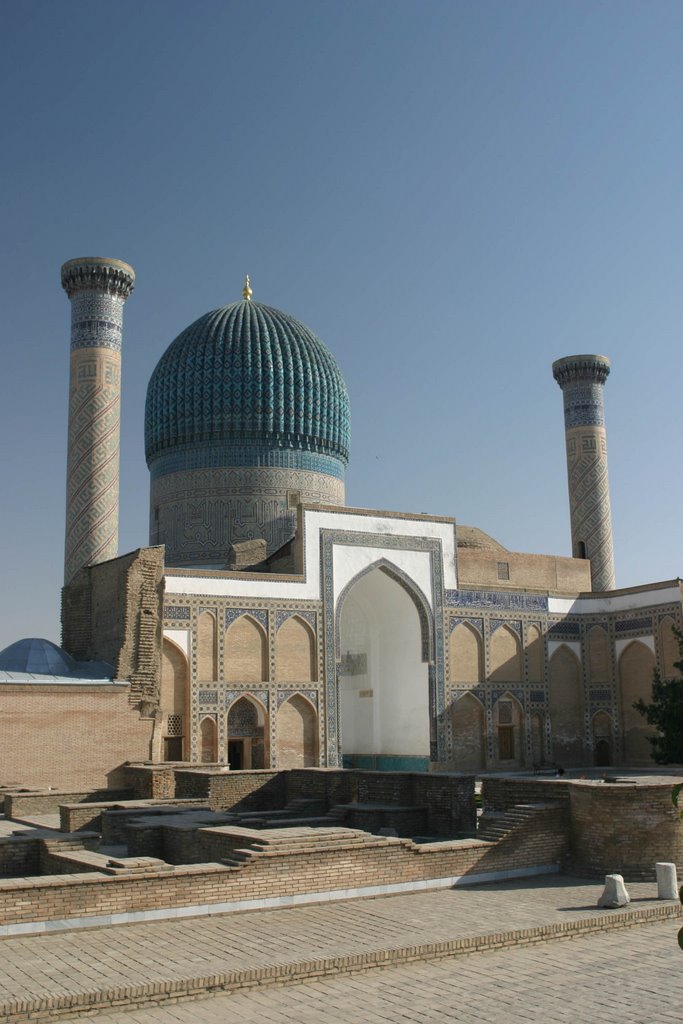
[Samarkand, Uzbekistan]


The following day we continued to Samarkand, the city build (OK made immortal) by Timur and his grandson Ulughbek. The sights here are even larger and more magnificent in scope than anything in Bukhara. Nevertheless I preferred Bukhara as being more compact and easier to traverse. Samarkand was one the greatest cities on the Silk Road, and the architecture shows this. The most spectacular sight is in the center of the city called The Registan, a collection of Medressas (Muslim schools) around a plaza. Tile work everywhere, on an unbelievable scale. I particularly enjoyed some of sloping walls, wondering when the whole thing would come crashing down. This is one of the single most impressive sights in Central Asia (says so in the Lonely Planet, and we agree). Of course there are a lot more sights all around, and the usual bazaars, markets and mausoleums. If I hadn't seen Bukhara first I would probably would have wanted to spend more time here. As it was sensory overload was already reaching critical.

Onward to Tashkent. Somewhere on the way to Tashkent, we passed Massimo going the opposite direction together with his passenger, unfortunately he didn't see us so we just continued. Tashkent, is a modern city with wide boulevards, very green, and large. We tend to try to avoid cities as a rule, and in Tashkent we only wanted to take care of a few minor errands before continuing. So after two days we moved on to Kazakhstan.


[Just outside Almaty, Kazakhstan]


Leaving Uzbekistan, and entering Kazakhstan were both fairly painless, the usual running around, but absolutely a breeze compared to Turkmenistan!! Something which will continue to be a mantra, "at least it isn't as bad Turkmenistan".
The main thing I noticed coming into Kazakhstan is that as soon as you get into the country the vistas change from the tended green fields in Uzbekistan, to huge flat golden plains something akin to what one sees in the Midwest of America or parts of south Australia. This image of Kazakhstan would remain the main memory of the Kazakhstan countryside. The bread basket of central Asia might be a good way to describe it.


[An Iranian, Motorcycle rider, in Kazakhstan]


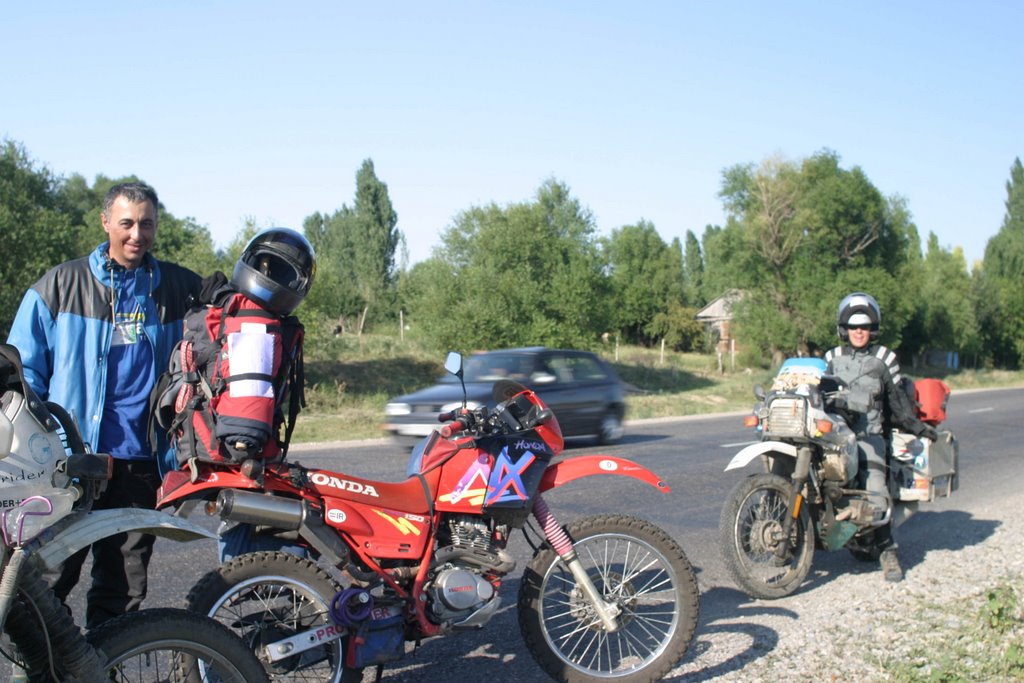
We rode from the border to Taraz before settling for the night. As in Uzbekistan, Turkmenistan, Azerbaijan, and Georgia our motorcycle evoked great curiosity and spontaneous gestures of friendship, not to mention some very dangerous traffic situations as cars passing us would suddenly slow down to get their cameras, or mobile phone cameras ready and then take pictures of us as they go by. At this rate maybe we will become famous somewhere! The following day we continued to Almaty.
In Almaty, we rented a small apartment for a few days so that I could do some maintenance on the bikes before heading to Mongolia. Almaty, or Alma Ata as it was called during Soviet times, turned out to be our first real culture shock. All signs were "only" in Cyrillic, so I spent a couple of days crash learning to read Cyrillic, which I managed. This meant we could at least read the signs, not necessarily understand what they meant, but it made things a lot easier. Almaty is also built on the "green" principle, lots of trees everywhere, business and housing behind leafy cover, often in blocks behind the cover of trees and sidewalks, and few signs at street level. Making finding anything a real challenge. A few other things also come to mind to describe Almaty, first, very very expensive. Many roads under construction (I hope), and some very interesting mix of old Soviet and new architecture. Some very unfriendly and unhelpful hotel staff, as in fulfilling every cliche about soviet area management. (I will write more about this when we get to Russia). Almaty is above all a business city, tourists have no reason to be here, for that matter, the whole country fails to achieve anything nearing a tourist destination. That is not to say that there are no tourist attractions here, simply that in my opinion it is not worth the effort or cost to come here to see them. Once here, we only wanted to leave. OK, but now I am starting to write too much already, so on we go. After getting the maintenance done on the bikes and stocking up on supplies (there are plenty of upscale supermarkets where you can get anything that you can anywhere else in the world), we start heading to the border of Russia, which we have to go through to get to Mongolia, as the Mongolian/Kazakhstan border is closed to foreigners.


[Reststop, Kazakhstan]


The route we took went through some of the places that during the soviet times was used to test nuclear weapons. The town of Emmey's major claim to fame is that just southwest of the city, the soviets exploded 467 (Lonely Planet) nuclear bombs. For me the more interesting history is that this is the town where Dostoevsky was exiled to for 5 years of forced military service and where he started the novel "The Brothers Karamazov". Other than the usual plains here, the thing that nearly killed us everyday was the road. These are by far the worst roads I have had the misfortune of having traversed. It was here that Cecilia broke the frame on her bike. The problem is that the road is for a the most part fine, and then suddenly without warning there is a dip, a hole, or just a chunk of road missing. So you are cruising about, nearly falling asleep because of the boring countryside, and suddenly BANG, your suspension just tried going through the seat, and you are hanging on to the handlebars for dear life!! In the end you start riding 40 km/h for a while but of course the road is fine, so then you speed up again and the process repeats. Very, very annoying, and dangerous. Getting the frame on Cecilia's bike fix wasn't too much of a problem. Every little town has a shop which has a welder (we did have to go around 100 km on the broken frame though!). After 10 minutes welding and 10$ later we were on our way again.


[Welding the frame on Cecilias bike, in Kazakhstan]


In due course we made it to the Kazakhstan/Russian border. The exit formalities for Kazakhstan were simple if a bit slow, as they only let a couple of people in at a time into the compound. The Russian side the same. Once inside everyone was friendly and moderately efficient. The procedure itself had some shades of Turkmenistan, but not nearly as bad. In about 1 1/2 hours we were through and into "Mother" Russia.

[Russia]


This was a major milestone for us.
We had decided to go to Novosibirsk to see about tires since we would be needing tires by the time we came back this way, and we were unable to get any in Almaty. So we proceeded with due haste to Novosibirsk. Russia continued the plains of Kazakhstan for the first 100 km or so and then became what we are used to from northern Europe, forest and hills, everything green and wonderfully warm. The roads were also in good condition (thank god).


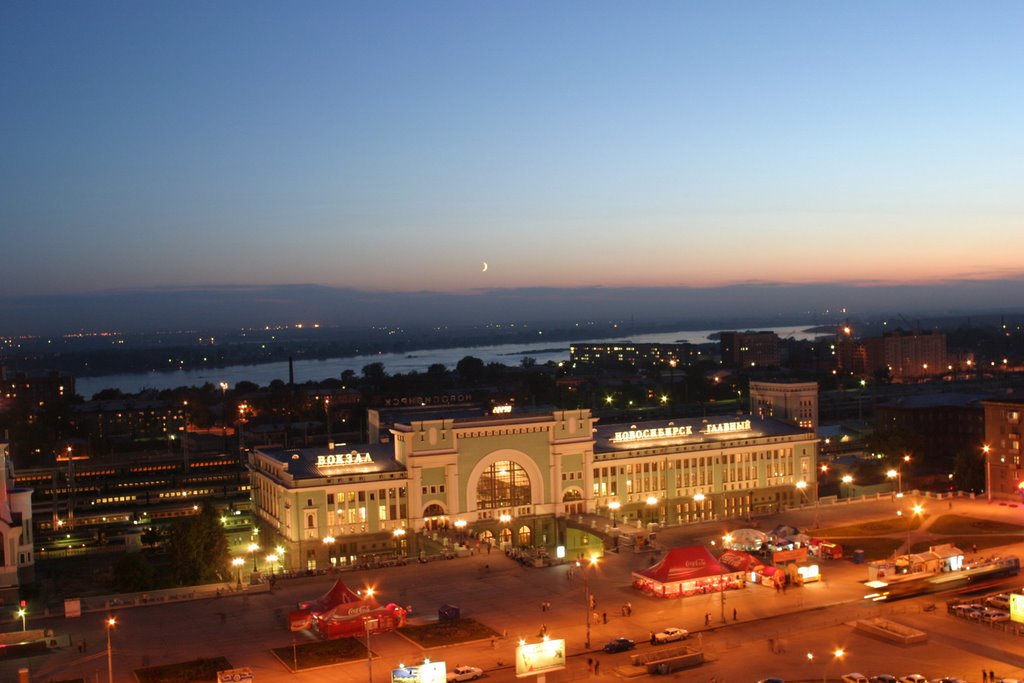
[Novosibirsk train station, Russia]


In Novosibirsk, we were very frustrated trying to find a hotel. First, there are only a few of them, second they are very expensive. The only cheap place I found after talking to a cab driver wouldn't even talk to me. Which brings me to my diatribe on Russian service centered economy. The Russians for the most part (based on our limited experience) don't understand the concept. I encountered a number of, invariably, older ladies, who simply took one look at me and decided they did not wish to serve me or chose to make it so difficult that it simply wasn't worth the effort. This ranged from being turned away from a hotel, to not being able to get gasoline because my 1000 ruble note was folded!! We have been in enough countries that I can make myself understood everywhere, but these babushkas simply didn't want the hassle of trying to deal with someone whom they could not communicate with. If this happened once or twice no big deal, people have a bad day, etc. etc. But this turned out to be the case in many places and I was very surprised if not a bit vexed occasionally. OK, we move on and give our money to someone else. Market economy prevails!! (Nearly, as there are very few hotels, your choice is not great). This was the first time; that the fact that we did not speak the local language was an issue. Very interesting!!

We eventually got a hotel at the "Hotel Novosibirsk" which is across from the train station. The hotel has two wings, one renovated, and the other in classical intourist standard. Basically a dump. For the cheaper rooms they are still asking for 100$ and getting it, unfortunately. After two days here we moved on, there were no tires to be had, we had chosen a holiday weekend to visit and everything was closed. So onward toward Mongolia.


[Typical campsite in the Altai region, Russia]


[Altai Region, Russia]


More in the next blog......